

What Is Workers Compensation and How Does It Work in Alabama?
If you have been injured at work, you are probably not concerned with legal terminology or the history of workers’ compensation laws. You are more likely asking practical questions such as:
- Who is going to pay my medical bills?
- Will I receive a workers’ compensation check while I am off work?
- Do I have to prove my employer did something wrong?
- What benefits am I entitled to?
Understanding the basics of Alabama’s Workers’ Compensation Act can help answer those questions.
What Is Workers’ Compensation?
Workers’ compensation is a system created to provide benefits to employees who are injured while performing their job duties. Unlike most personal injury claims, workers’ compensation is generally a no-fault system. This means that an injured worker usually does not have to prove that their employer was negligent or did something wrong in order to receive benefits.
Instead, the worker generally must show:
- They suffered an injury arising out of and occurring in the course of their employment;
- The worker was not guilty of any willful misconduct;
- The injury was reported within the time required by law; and
- The injury resulted in a need for medical treatment or caused disability.
Why Does Workers’ Compensation Exist?
Before workers’ compensation laws were enacted, an injured worker often had only one option-sue their employer. Unfortunately, winning those lawsuits was often difficult as employers had several legal defenses available, including:
- Assumption of the risk;
- Contributory negligence; and
- The fellow-servant rule.
As a result, many seriously injured workers recovered nothing. Workers’ compensation laws were created as a compromise between employers and employees, to protect both parties.
What Employees Gave Up
Under the workers’ compensation system, employees generally give up the right to sue their employer for:
- Pain and suffering;
- Emotional distress;
- Punitive damages; and
- Many other damages available in traditional personal injury lawsuits.
What Employers Gave Up
In exchange, employers generally lose the ability to defend claims by arguing:
- The employee was partially at fault;
- The employee assumed the risk of injury; or
- Another employee caused the accident.
The result is a system designed to provide benefits more quickly and efficiently than traditional litigation.
What Benefits Does Alabama Workers’ Compensation Provide?
Alabama’s Workers’ Compensation Act provides several different types of benefits.
Medical Benefits
Perhaps the most important benefit is medical treatment. By law, the employer is generally responsible for providing and paying for:
- Doctor visits;
- Surgery;
- Physical therapy;
- Prescription medication;
- Diagnostic testing;
- Pain management treatment; and
- Other reasonably necessary medical care related to the work injury.
In many cases, medical benefits may continue long after disability benefits have ended as the injured workers’ medical benefits are for life unless (i) they settle their right to future medical care or (ii) they suffer another accident to the body part-making it worse.
Income Benefits
Workers who lose wages because of a work injury may also be entitled to workers’ compensation checks. These benefits are designed to replace a portion of the worker’s lost income. The most common forms of wage replacement benefits are:
Temporary Total Disability (TTD)
TTD benefits are generally paid when an injured worker is completely unable to work while recovering from a workplace injury.
Temporary Partial Disability (TPD)
TPD benefits may be available when a worker returns to work but earns less money because of restrictions related to the injury.
Permanent Disability Benefits
Not every worker fully recovers from a workplace injury. When a permanent impairment remains after treatment has been completed, additional benefits may be available.
Depending on the nature and severity of the injury, a worker may be entitled to:
- Permanent Partial Disability (PPD) benefits; or
- Permanent Total Disability (PTD) benefits.
Vocational Benefits
In some cases, a workplace injury may prevent a worker from returning to their previous occupation. When this occurs, the injured worker may be entitled to vocational consideration, which takes into their permanent physical restrictions, age, education and prior work experience.
Death Benefits
When a workplace accident results in death, surviving dependents may be entitled to workers’ compensation death benefits.
Do I Have to Prove My Employer Was At Fault?
Generally, no. One of the most important features of Alabama’s workers’ compensation system is that benefits are usually available regardless of who caused the accident.
For example:
- A worker who slips and falls;
- A worker injured while lifting;
- A worker struck by falling materials; or
- A worker involved in a workplace vehicle accident
may still be entitled to workers’ compensation benefits even if the employer did nothing wrong. The focus is usually on whether the injury arose out of and occurred during the course of employment.
What Should I Do After a Work Injury?
If you believe you have suffered a workplace injury, it is generally important to:
- Report the injury to your employer as soon as possible;
- Request medical treatment if needed;
- Ensure that a First Report of Injury is completed;
- Follow your physician’s recommendations; and
- Keep records relating to your injury and treatment.
Prompt reporting can help avoid disputes concerning notice and causation.
Workers’ compensation exists to provide medical treatment and financial support to workers who are injured while performing their job duties, and while Alabama’s workers’ compensation system can be complicated, understanding the basic benefits available under the law can help injured workers better protect their rights and make informed decisions after a workplace injury.
If you have suffered a job injury and you have questions about your rights and benefits under Alabama’s workers compensation laws -don’t hesitate to contact and speak with one of the experienced Alabama Workers Compensation and Social Security Disability attorneys at Powell and Denny today for a free consultation. Appointments are available in person, or virtually via Zoom if more convenient. Powell and Denny would appreciate the opportunity to help. And remember, there is no fee unless you win.
Powell and Denny: We Work When You Can’t
Offices in Birmingham and Huntsville, Alabama
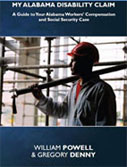
We Wrote the Book
My Alabama Disability Claim by William Powell & Gregory Denny Click Here to Get Your Free Copy


-
 5.0/5.0
A++++++ got results and staff is friendly
-
5.0/5.0
A++++++ got results and staff is friendly
-
5.0/5.0
Persevering for 2-3 years to get my disability. Thank You.
-
5.0/5.0
Persevering for 2-3 years to get my disability. Thank You.
-
 5.0/5.0
William Powell is an excellent attorney and a leader in our local bar.
