
What Is Uninsured and Underinsured Motorist Coverage in Alabama?
You are stopped at a red light when another driver crashes into the back of your vehicle. You are seriously injured and there is no real dispute that the other driver caused the wreck.
Then you discover another problem-the driver does not have automobile liability insurance. Or perhaps the driver has insurance, but only enough coverage to pay a small portion of your damages.
What happens then?
One possible source of recovery may be uninsured or underinsured motorist coverage, commonly called UM/UIM coverage.
And the surprising part is that this coverage may come from your own automobile insurance policy.
Alabama has a statute specifically governing uninsured motorist coverage: Ala. Code § 32-7-23.
Understanding this coverage can be extremely important after a serious Alabama car wreck because proving that another driver caused your injuries does not necessarily mean that driver has enough insurance—or any insurance—to compensate you for those injuries.
What Is Uninsured Motorist Coverage?
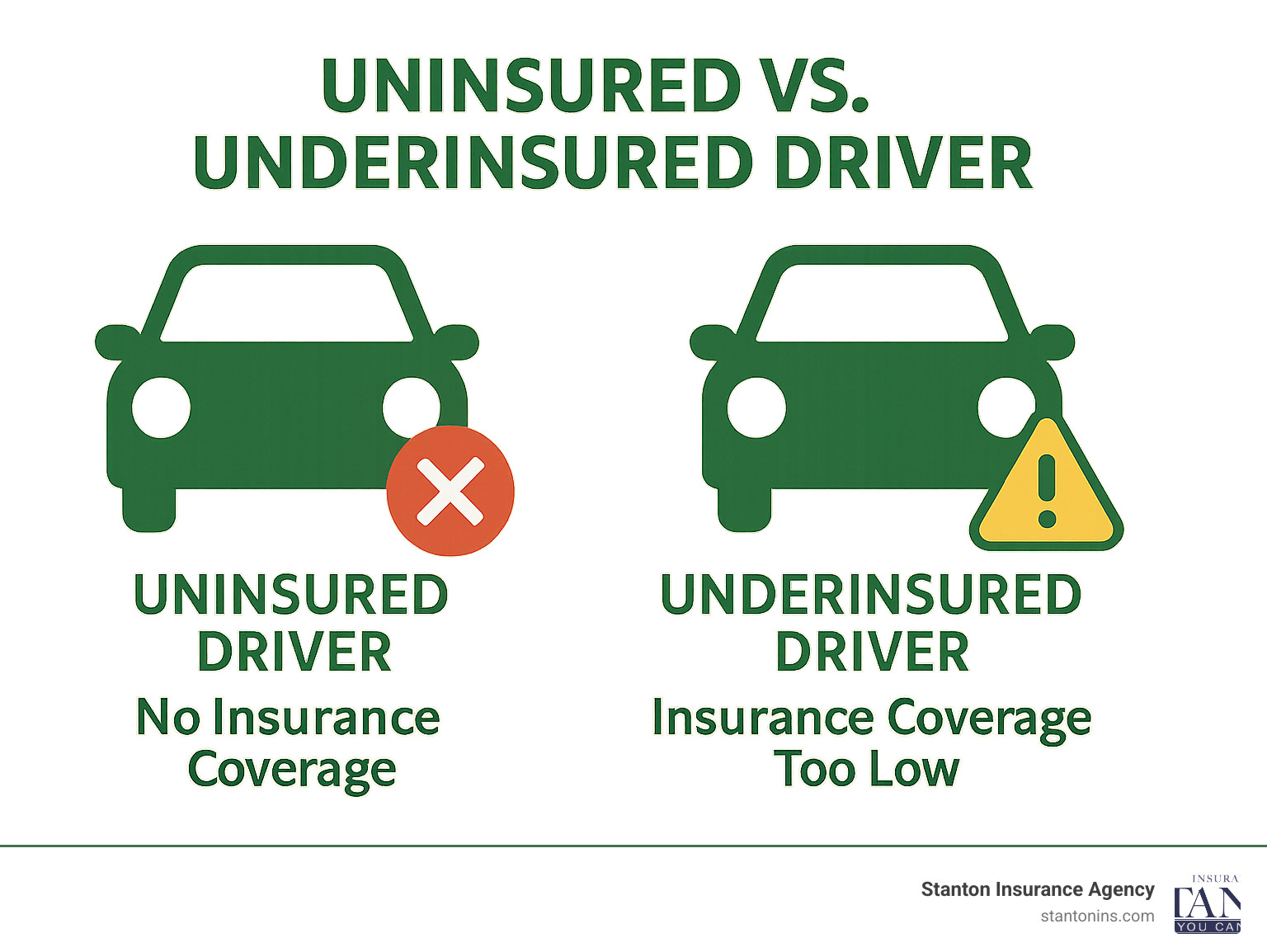
Uninsured motorist coverage generally protects an insured person who is legally entitled to recover damages from the owner or operator of an uninsured motor vehicle. The basic situation is straightforward.
Suppose another driver negligently causes a wreck that seriously injures you. Your damages are $100,000, but the driver who caused the wreck has no automobile liability insurance.
Winning a claim against someone who has no insurance and no meaningful assets may do little to compensate you for your injuries; that is one of the problems uninsured motorist coverage is designed to address.
If you have applicable UM coverage, you may be able to make a claim under that coverage for damages you are legally entitled to recover from the uninsured driver.
What Is Underinsured Motorist Coverage?
An underinsured driver has liability insurance, but the available liability coverage is insufficient to compensate the injured person fully for his or her damages.
For example, suppose another driver causes a wreck and you suffer serious injuries. Your legally recoverable damages are $150,000.
The driver who caused the wreck has only $25,000 in bodily-injury liability coverage available to you. The driver is insured.
The problem is that the driver does not have enough insurance. That is where underinsured motorist coverage may become important.
Alabama’s uninsured motorist statute includes underinsured motor vehicles within its protection when the available liability coverage is less than the damages the injured person is legally entitled to recover.
So, although lawyers and insurance companies frequently use the abbreviation UM/UIM, Alabama’s underinsured motorist protection is part of the statutory uninsured-motorist framework.
Why Would My Insurance Company Have to Pay When the Other Driver Caused the Wreck?
This is one of the most common sources of confusion.
You may think: “The other driver caused the wreck. Why would I make a claim against my own insurance?”
Because UM/UIM coverage is coverage that may exist under your insurance contract for precisely this type of situation. You paid for insurance protection.
Depending upon the policy and circumstances, part of that protection may include coverage for injuries caused by motorists who have no insurance or insufficient insurance.
That does not mean your insurance company caused the wreck; it means your policy may provide a source of compensation when the person who did cause it lacks adequate liability insurance.
Does Alabama Require Automobile Policies to Include UM/UIM Coverage?
Alabama law provides substantial protection here.
Under Ala. Code § 32-7-23(a), an automobile or motor-vehicle liability policy issued or delivered in Alabama for a vehicle registered or principally garaged here generally must provide uninsured motorist coverage for insured persons who are legally entitled to recover damages from owners or operators of uninsured motor vehicles because of bodily injury, sickness, disease, or death.
But there is an important exception. The named insured has the right to reject the coverage.
That distinction matters. UM/UIM coverage is not something that should simply be assumed to exist in every Alabama automobile policy.
A valid rejection can change the analysis.
Can I Reject Uninsured Motorist Coverage in Alabama?
Yes.
Alabama law permits the named insured to reject UM coverage. Alabama appellate courts have repeatedly emphasized the significance of who actually rejected the coverage.
For example, in Progressive Specialty Insurance Co. v. Gore, the automobile policy was issued with the husband as the sole named insured. His wife had signed the UM rejection form during the application process, but the husband had not.
The Alabama Supreme Court held that the wife’s purported rejection was ineffective because she was not the named insured. The Court explained that, absent a valid rejection by the named insured, Alabama’s uninsured motorist statute mandates the coverage.
That illustrates why the paperwork matters.
If an insurance company says that UM/UIM coverage was rejected, one of the questions may be: Who actually signed the rejection?
The answer can matter.
What Does “Legally Entitled to Recover” Mean?
Section 32-7-23 protects insured persons who are “legally entitled to recover damages” from the owner or operator of the uninsured motor vehicle.
Those words are important.
UM/UIM coverage is not simply a payment that becomes due because the other driver lacks sufficient insurance. The injured person ordinarily still must establish the underlying right to recover damages.
That may involve issues such as:
- whether the other driver was negligent or otherwise legally responsible;
- whether the injured person was contributorily negligent;
- whether the collision caused the claimed injuries; and
- the amount of legally recoverable damages.
Alabama’s UM statute does not provide benefits simply because an uninsured motorist caused an accident. Under Ala. Code § 32-7-23, the insured must be “legally entitled to recover damages” from the owner or operator of the uninsured motor vehicle.
That generally means the injured person must have a legally recoverable claim against the motorist whose conduct forms the basis of the UM claim.
Ex parte Carlton, 867 So. 2d 332 (Ala. 2003) illustrates how important that requirement can be.
Carlton was injured while riding in an employer-owned vehicle being driven by a coemployee. Although the coemployee’s negligence allegedly caused the wreck, Alabama workers’ compensation law prevented Carlton from recovering negligence damages from the coemployee.
The Alabama Supreme Court held that because Carlton was not legally entitled to recover damages from the coemployee, he could not obtain UM benefits based upon the coemployee’s negligence. In reaching that decision, the Court expressly overruled earlier Alabama cases to the extent they had allowed UM recovery even though another substantive rule of Alabama law prevented the injured person from recovering against the motorist. The Court subsequently confirmed that interpretation in Continental National Indemnity Co. v. Fields.
The principle is important:
UM/UIM coverage can address a lack of adequate insurance, but it does not ordinarily create a right to recover when Alabama substantive law says the injured person is not legally entitled to recover damages from that motorist.
That does not mean that receiving workers’ compensation benefits automatically prevents an employee from recovering UM/UIM benefits.
For example, an employee injured in a work-related wreck may have a legally enforceable claim against an unrelated negligent third-party driver. Alabama law can permit both a workers’ compensation claim and a claim against that third party. The critical question for UM/UIM purposes is whether the injured person is legally entitled to recover damages from the particular motorist whose conduct forms the basis of the UM/UIM claim.
Recommended Readings: I Was Injured as a Passenger in an Alabama Car Wreck. Can I Recover Damages?
Can I Have Both a Workers Compensation Claim and a Personal Injury Claim?
So, UM/UIM coverage does not eliminate the need to establish the underlying legal claim.
Recommended Reading: The Insurance Company Says the Car Wreck Was Partly My Fault. Can I Still Recover in Alabama?
Does Alabama’s Contributory-Negligence Rule Apply to a UM/UIM Claim?
Potentially, yes.
Because the insured generally must be legally entitled to recover damages from the uninsured or underinsured motorist, defenses that would defeat the underlying negligence claim can matter to the UM/UIM claim as well. That makes Alabama’s contributory-negligence doctrine particularly important.
Suppose an uninsured driver was negligent, but the evidence also establishes that the injured driver was contributorily negligent and that the injured driver’s negligence proximately contributed to the collision. Alabama’s contributory-negligence rule may prevent recovery on the underlying negligence claim.
If the injured person is not legally entitled to recover damages from the uninsured motorist, that can affect the UM claim as well.
This is another reason your own insurance company may investigate fault rather than simply accepting your description of what happened.
What If the Driver Who Hit Me Has Some Insurance, but It Isn’t Enough?
That is the classic underinsured-motorist situation.
Suppose your damages are substantially greater than the liability insurance available from the person who caused the wreck. You may need to investigate whether applicable UIM coverage exists, but there is an important warning:
Do not assume that you should simply accept the at-fault driver’s policy limits, sign a general release, and then ask your own insurance company for the rest.
Alabama has developed specific procedures governing settlements with underinsured motorists when a UIM carrier is involved. The leading case is Lambert v. State Farm Mutual Automobile Insurance Co.
Among other things, Lambert addresses notice to the UIM carrier, a proposed settlement with the underinsured driver, the insurer’s opportunity to investigate, and protection of the UIM carrier’s potential subrogation rights.
We will address that process in greater detail in the next article in this series.
Recommended Reading: What If the Driver Who Hit Me Doesn’t Have Enough Insurance to Pay for My Injuries?
What If the Other Driver Leaves the Scene and Is Never Identified?
UM coverage can also become important when the negligent driver cannot be identified.
Consider a driver who forces your vehicle off the road and then leaves the scene. No one gets the license-plate number. The driver and vehicle are never found.
This is sometimes called a phantom-vehicle situation.
Alabama law has an important history on this issue. In Walker v. GuideOne Specialty Mutual Insurance Co., an unidentified vehicle allegedly crossed into the insured driver’s lane. She swerved to avoid it, left the roadway, and struck a tree.
There was no physical contact between the vehicles.
The insurance policy attempted to require corroborating evidence from someone other than a person making a claim under the policy, but the Alabama Supreme Court held that the policy provision was more restrictive than Alabama’s uninsured motorist statute and was therefore unenforceable. The Court explained that an insurer could not contractually impose a higher evidentiary hurdle that excluded a person who otherwise could establish that he or she was legally entitled to recover under § 32-7-23.
That is significant.
The absence of physical contact does not necessarily mean there can be no Alabama UM claim involving an unidentified vehicle.
Of course, proving what actually happened may become a serious factual issue when the other vehicle disappears and there are no independent witnesses.
Evidence still matters.
Do I Need to Know Who the Hit-and-Run Driver Was?
Not necessarily.
One of the purposes of uninsured motorist coverage is to address circumstances in which the legally responsible motorist may be uninsured or unidentified, but the injured person still needs sufficient evidence to establish the underlying claim.
Depending upon the circumstances, useful evidence could include:
- eyewitness testimony;
- photographs of the scene;
- surveillance video;
- traffic-camera footage;
- dash-camera video;
- physical evidence from the roadway;
- vehicle damage;
- 911 recordings;
- statements made immediately after the wreck; and
- accident-reconstruction evidence.
The inability to identify the driver does not automatically eliminate a UM claim, but it can make prompt evidence preservation especially important.
Can a Passenger Have an Uninsured or Underinsured Motorist Claim?
Yes, depending upon the policy and circumstances.
UM/UIM coverage is not necessarily limited to the person driving the insured vehicle. Policy definitions matter, and Alabama law recognizes circumstances in which passengers qualify as insureds.
In Travelers Insurance Co. v. Jones, for example, passengers injured while riding in an insured vehicle were insured under the UM provisions of the policy.
Whether a particular passenger is covered depends upon the applicable insurance contract and Alabama law. That is another reason not to assume that the only relevant insurance policy after a serious wreck is the policy belonging to the person who was driving.
What Does It Mean to “Stack” UM/UIM Coverage?
Alabama permits UM/UIM coverage to be stacked in certain circumstances. Stacking means combining applicable UM/UIM coverages rather than being limited to a single coverage limit.
Suppose, for example, that an insurance policy covers several vehicles and UM/UIM premiums or coverages apply to those vehicles. Depending upon the policy and the person’s status as an insured, Alabama law may allow multiple coverages to be combined.
But stacking is not unlimited.
Ala. Code § 32-7-23(c) provides that recovery by an injured person under the uninsured provisions of any one automobile insurance contract is limited to the primary coverage plus coverage provided for no more than two additional vehicles within that contract.
In Mid-Century Insurance Co. v. Watts, the Alabama Supreme Court explained that this means an injured insured may stack a maximum of three UM coverages under a single policy: the primary coverage plus two additional coverages.
This can make a substantial difference.
If applicable UM/UIM limits were $50,000 and three coverages could properly be stacked, the potentially available UM/UIM coverage under that policy could be significantly greater than a single $50,000 limit-but stacking can become legally complicated.
The number of vehicles, number of policies, identity of the named insured, the claimant’s relationship to the named insured, whether the claimant occupied a covered vehicle, and the language of the policies can all matter.
How Do I Know Whether I Am an “Insured”?
That can depend heavily upon the policy language. Potential insureds may include, depending upon the particular policy:
- the named insured;
- a spouse;
- resident relatives;
- occupants of a covered automobile; or
- other persons fitting the policy’s definition of an insured.
Those categories should not be assumed. The actual policy should be obtained and reviewed.
A person’s status can also affect which coverages may be stacked. For example, being an insured because you were occupying a particular covered automobile does not necessarily mean you are an insured under every other automobile policy issued to someone else.
Can I Recover More Than My Actual Damages by Stacking Coverage?
No.
Stacking potentially increases the amount of insurance coverage available; tt does not multiply the amount of the loss itself.
The Alabama Supreme Court has explained that where an insured’s loss exceeds one UM limit, applicable coverages may be stacked to compensate the insured up to the damages legally recoverable, subject to the governing statutory and policy limitations. If the legally recoverable damages are $75,000, the existence of $150,000 in stacked UM coverage does not ordinarily transform a $75,000 claim into a $150,000 claim.
Coverage and damages are two different concepts.
Does My Own Insurance Company Automatically Agree With Me About What My Claim Is Worth?
No.
This is another misconception about UM/UIM claims. You may be making a claim under your own policy, but your insurance company still has a financial interest in determining what it is legally obligated to pay.
The insurer may investigate:
- who caused the wreck;
- contributory negligence;
- medical causation;
- prior injuries;
- whether treatment was related to the collision;
- the extent of any permanent injury;
- lost wages;
- future medical treatment; and
- the amount of damages.
So, an uninsured or underinsured motorist claim can become contested even though the claim is made under your own policy.
Recommended Reading: Should I Give the Insurance Company a Recorded Statement After an Alabama Car Wreck?
What Damages Can UM/UIM Coverage Potentially Include?
Because § 32-7-23 focuses on damages the insured is legally entitled to recover from the uninsured motorist, the analysis begins with the damages legally recoverable on the underlying claim.
Depending upon the facts, those damages may involve matters such as:
- medical expenses;
- lost income;
- physical pain;
- mental anguish;
- permanent injury;
- physical limitations; and
- other damages recoverable under Alabama law.
The existence of damages does not mean every claimed amount will be accepted by the insurer. Liability, causation, damages, policy limits, available coverage, and other insurance may all have to be resolved.
How Do I Find Out Whether UM/UIM Coverage Is Available?
Do not rely solely on someone’s recollection that “I think we rejected it” or “I think we only have liability coverage.”
Obtain the actual insurance information. Depending upon the case, relevant documents can include:
- the declarations page;
- the complete automobile policy;
- endorsements;
- UM/UIM rejection forms;
- insurance applications;
- renewal documents; and
- policies covering other potentially applicable vehicles.
If the insurer claims the coverage was rejected, the rejection itself may need to be examined.
If multiple vehicles or policies are involved, each potentially applicable policy may need to be evaluated.
Why Should UM/UIM Coverage Be Investigated Early?
Because insurance coverage can affect decisions made during the claim. One of the most important examples occurs when the at-fault driver’s liability insurer offers its policy limits.
An injured person may understandably think: “They offered everything they have. I’ll take it and sign the release,” but if an underinsured motorist claim exists, signing a release without following the required procedures can jeopardize that claim.
Under Alabama law, the UIM carrier may have rights that must be protected before the underinsured driver is released, that is why identifying potential UM/UIM coverage before settling with the at-fault driver’s insurer can be so important.
Alabama UM/UIM Coverage Can Be More Important Than You Realize
After a serious car wreck, most people understandably focus first on the insurance carried by the driver who caused it, but that may be only part of the insurance investigation.
If the other driver is uninsured, has inadequate liability limits, or cannot be identified, uninsured or underinsured motorist coverage may provide another potential source of recovery.
Alabama law provides significant statutory protection through Ala. Code § 32-7-23, but UM/UIM claims can involve difficult questions about:
- whether coverage was validly rejected;
- who qualifies as an insured;
- whether the injured person is legally entitled to recover;
- hit-and-run or phantom vehicles;
- contributory negligence;
- stacking;
- multiple policies;
- damages; and
- preserving UIM rights before settling with the at-fault driver.
The insurance policy itself matters, and so does the procedure followed during the claim. In the next article in this series, we will examine a related practical problem:
What happens when the person who caused your Alabama car wreck has insurance—but does not have enough insurance to compensate you for your injuries?
That is where underinsured motorist coverage and Alabama’s procedures for resolving the at-fault driver’s liability limits become especially important.
If you were seriously injured by an uninsured or underinsured driver in Alabama, and you have questions about what benefits you are entitled to — don’t hesitate to contact and speak with one of the experienced Alabama Car Wreck attorneys at Powell and Denny today for a free consultation. Appointments are available in person, or virtually via Zoom if more convenient. Powell and Denny would appreciate the opportunity to help. And remember, there is no fee unless you win.
Powell & Denny: We Work When You Can’t.
This article provides general information about Alabama law and is not legal advice concerning any particular case.
We Wrote the Book
My Alabama Disability Claim by William Powell & Gregory Denny Click Here to Get Your Free Copy


-
 5.0/5.0
A++++++ got results and staff is friendly
-
5.0/5.0
A++++++ got results and staff is friendly
-
5.0/5.0
Persevering for 2-3 years to get my disability. Thank You.
-
5.0/5.0
Persevering for 2-3 years to get my disability. Thank You.
-
 5.0/5.0
William Powell is an excellent attorney and a leader in our local bar.
