

What If My Injuries Permanently Prevent Me From Working After an Alabama Car Wreck?
A serious car wreck can change your life in ways that go far beyond medical bills.
Perhaps you worked in construction for twenty years, but a back injury now prevents you from lifting heavy materials. Maybe you were a truck driver who can no longer tolerate sitting behind the wheel for hours. Or you worked as a nurse and can no longer lift or transfer patients.
Your doctor tells you that your condition may be permanent.
You are left wondering: What happens if I can never return to the job that supported my family?
Under Alabama law, several different types of benefits or compensation may be available. Depending on how the injury occurred and how it affects your ability to work, you may have a personal-injury claim, a workers’ compensation claim, or qualify for Social Security Disability benefits. Understanding the differences is important because these systems do not use the same rules.
Can I Recover Compensation If a Car Wreck Permanently Ends My Career?
Yes, potentially.
If another driver’s negligence causes an injury that permanently reduces your ability to earn a living, that economic loss may be part of your Alabama personal-injury claim. This is called loss of earning capacity.
It is different from recovering the wages you missed while receiving treatment.
For example, suppose a 45-year-old construction worker earns $65,000 annually before a collision. After the accident, permanent back restrictions prevent the worker from returning to construction. The worker eventually finds a less physically demanding job earning $35,000 per year. That $30,000 annual difference may be important evidence of diminished earning capacity, although the actual calculation involves additional considerations.
The worker may have many years of employment remaining. Consequently, the financial impact of the injury could extend well beyond the initial recovery period.
We explain the distinction between past lost earnings and future earning capacity in our related article, “Can I Recover Lost Wages If a Car Wreck Keeps Me From Working in Alabama?”
Does a Permanent Medical Impairment Mean I Am Permanently Disabled?
Not necessarily.
A physician may assign a permanent impairment rating after determining that an injury has reached maximum medical improvement, but an impairment rating measures physical or functional loss under a medical rating system. It does not automatically determine whether a person can return to work or how much income that person can earn. The Alabama Supreme Court addressed this distinction in Carnival Cruise Lines, Inc. v. Snoddy, 457 So. 2d 379, 381–84 (Ala. 1984). Here, the Court explained that the same physical injury can have very different effects on different occupations.
An injury affecting the use of a hand may have limited consequences for someone working at a desk, but devastating consequences for a surgeon, musician, or construction worker. The important question is how the injury affects the particular person’s ability to earn a living.
For someone whose career depends on physical labor, a permanent restriction against heavy lifting may be far more significant than the impairment percentage suggests.
What If I Cannot Return to My Old Job but Could Perform Other Work?
That distinction can have a major effect on your claim. Suppose a truck driver can no longer operate commercial vehicles because of permanent spinal injuries.
The insurance company may argue that the driver can still perform office work, but the fact that someone is physically capable of performing a desk job does not establish that the person has the education, experience, or opportunity to obtain comparable employment. A proper evaluation may consider your age, education, work history, transferable skills, medical restrictions, and realistic employment opportunities.
This is where vocational evidence can become important.
A vocational expert may evaluate the types of work you can still perform and what those jobs ordinarily pay.
If the collision has reduced your earning capacity, that loss may be compensable even though you are not completely unable to work.
Recommended reading: What Does “Loss of Earning Capacity” Mean in an Alabama Workers’ Compensation Case?
What If I Was Injured in a Car Wreck While Working?
If the collision occurred while you were performing your job, Alabama workers’ compensation may provide an additional source of benefits.
Consider a delivery driver injured when another motorist runs a red light. The driver may have a workers’ compensation claim because the injury occurred during covered employment. The driver may also have a personal-injury claim against the negligent motorist.
Under Ala. Code § 25-5-11(a), qualifying employees may pursue a third-party claim while receiving workers’ compensation benefits; however, reimbursement and credit rules may affect the relationship between the two claims.
That means a settlement with the negligent motorist should be evaluated alongside the workers’ compensation case.
We address these issues in greater detail in “Can I File Both a Workers’ Compensation Claim and a Car Wreck Lawsuit in Alabama?” and “Will I Have to Pay Workers Compensation Back If I Settle a Related Personal Injury Claim?”
What Does Permanent Total Disability Mean Under Alabama Workers’ Compensation?
Alabama workers’ compensation uses a specific legal definition of permanent total disability. Under Ala. Code § 25-5-57(a)(4), the question involves whether the work-related injury permanently prevents the employee from performing the former trade and obtaining other reasonably gainful employment, including consideration of retraining.
An employee does not have to be bedridden or physically helpless to qualify.
The Alabama Court of Civil Appeals explained this principle in Mead Paper Co. v. Brizendine, 575 So. 2d 571, 574–75 (Ala. Civ. App. 1990). Here, the Court explained that an inability to return to the former trade is only part of the inquiry. The employee’s ability to obtain other gainful employment, including through feasible retraining, must also be considered.
For example, a 58-year-old heavy-equipment operator with limited formal education and permanent physical restrictions may face very different employment prospects from a younger worker with substantial computer and administrative experience.
A finding of permanent total disability may entitle a qualifying employee to continuing workers’ compensation benefits under Alabama law, but those benefits are governed by the workers’ compensation statute, not by the rules that determine damages in an ordinary car wreck lawsuit.
Recommended reading: What Happens If I Don’t Fully Recover? Understanding Permanent Disability Benefits in Alabama Workers Compensation Claims
Can I Receive Social Security Disability If I Can No Longer Work?
Possibly.
Social Security Disability Insurance (SSDI) is a federal program with its own eligibility requirements. To qualify, an applicant generally must have sufficient covered work history and a medically determinable impairment that prevents substantial gainful activity and has lasted, or is expected to last, at least twelve continuous months or result in death.
Social Security also evaluates whether the applicant can perform previous work or adjust to other work, considering the applicable medical and vocational rules.
Being unable to return to your old job does not automatically qualify you for SSDI.
For example, a construction worker with permanent lifting restrictions may be unable to perform heavy labor but still have the capacity to perform other employment.
Whether that worker qualifies for SSDI depends on the federal disability rules and the individual’s circumstances. Age, education, work experience, medical restrictions, and other relevant factors can be important.
We will examine these requirements more fully in our next Social Security Disability article, “Can I Get Social Security Disability After a Serious Car Wreck?”
Can I Receive Workers’ Compensation and Social Security Disability at the Same Time?
Yes, in some circumstances, an injured employee may qualify for both workers’ compensation and SSDI; however, receiving workers’ compensation can reduce SSDI benefits under the federal workers’ compensation offset rules. The calculation depends on the applicable benefits, earnings history, and other factors. Certain workers’ compensation settlements can also affect the calculation.
A personal-injury recovery against a negligent driver is not automatically treated the same way as workers’ compensation for SSDI offset purposes.
These distinctions matter when someone has a serious injury and several potential claims. Before settling a workers’ compensation case, the injured person should understand how the settlement may affect Social Security benefits and future medical treatment.
Recommended reading: I Was Seriously Hurt at Work and Can’t Work, Can I Receive Workers’ Compensation and Social Security Disability Benefits?
What Should I Do If My Doctor Says I May Never Return to My Job?
First, obtain a clear understanding of your medical restrictions and prognosis. Ask your physician to explain which job duties you should avoid and whether those restrictions are expected to be permanent.
Keep records of your employment history, earnings, and attempts to return to work.
If your employer offers modified duties, make sure the proposed work is consistent with your medical restrictions.
You should also consider the potential interaction between a personal-injury claim, workers’ compensation benefits, and Social Security Disability before agreeing to a settlement.
These systems may overlap, but they have different eligibility rules, deadlines, and financial consequences.
A Permanent Injury Can Change More Than Your Health
For many people, work is more than a paycheck. It represents years of experience, financial security, and the ability to support a family. A serious car wreck can threaten all of those things.
Alabama personal-injury law may provide compensation for diminished earning capacity. Workers’ compensation may provide disability benefits when the injury occurred during covered employment. Social Security Disability may provide another source of income when the federal requirements are satisfied.
But qualifying under one system does not automatically mean you qualify under the others.
Understanding the differences is essential when an injury permanently changes your ability to work.
Talk With Powell & Denny About a Serious Injury That Prevents You From Working
If a serious Alabama car wreck has left you unable to return to your former occupation, your legal options may involve more than an ordinary insurance claim.
At Powell & Denny, P.C., we represent injured Alabamians in personal-injury, workers’ compensation, and Social Security Disability matters. We understand how permanent physical restrictions can affect employment, earning capacity, and financial security, so if you or a loved one has been seriously injured and are unable to return to your job- don’t hesitate to contact and speak with one of the experienced Alabama Car Wreck attorneys at Powell and Denny today for a free consultation. Appointments are available in person, or virtually via Zoom if more convenient. Powell and Denny would appreciate the opportunity to help. And remember, there is no fee unless you win.
Powell & Denny: We Work When You Can’t.
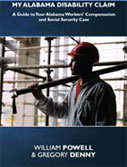
We Wrote the Book
My Alabama Disability Claim by William Powell & Gregory Denny Click Here to Get Your Free Copy


-
 5.0/5.0
A++++++ got results and staff is friendly
-
5.0/5.0
A++++++ got results and staff is friendly
-
5.0/5.0
Persevering for 2-3 years to get my disability. Thank You.
-
5.0/5.0
Persevering for 2-3 years to get my disability. Thank You.
-
 5.0/5.0
William Powell is an excellent attorney and a leader in our local bar.
