
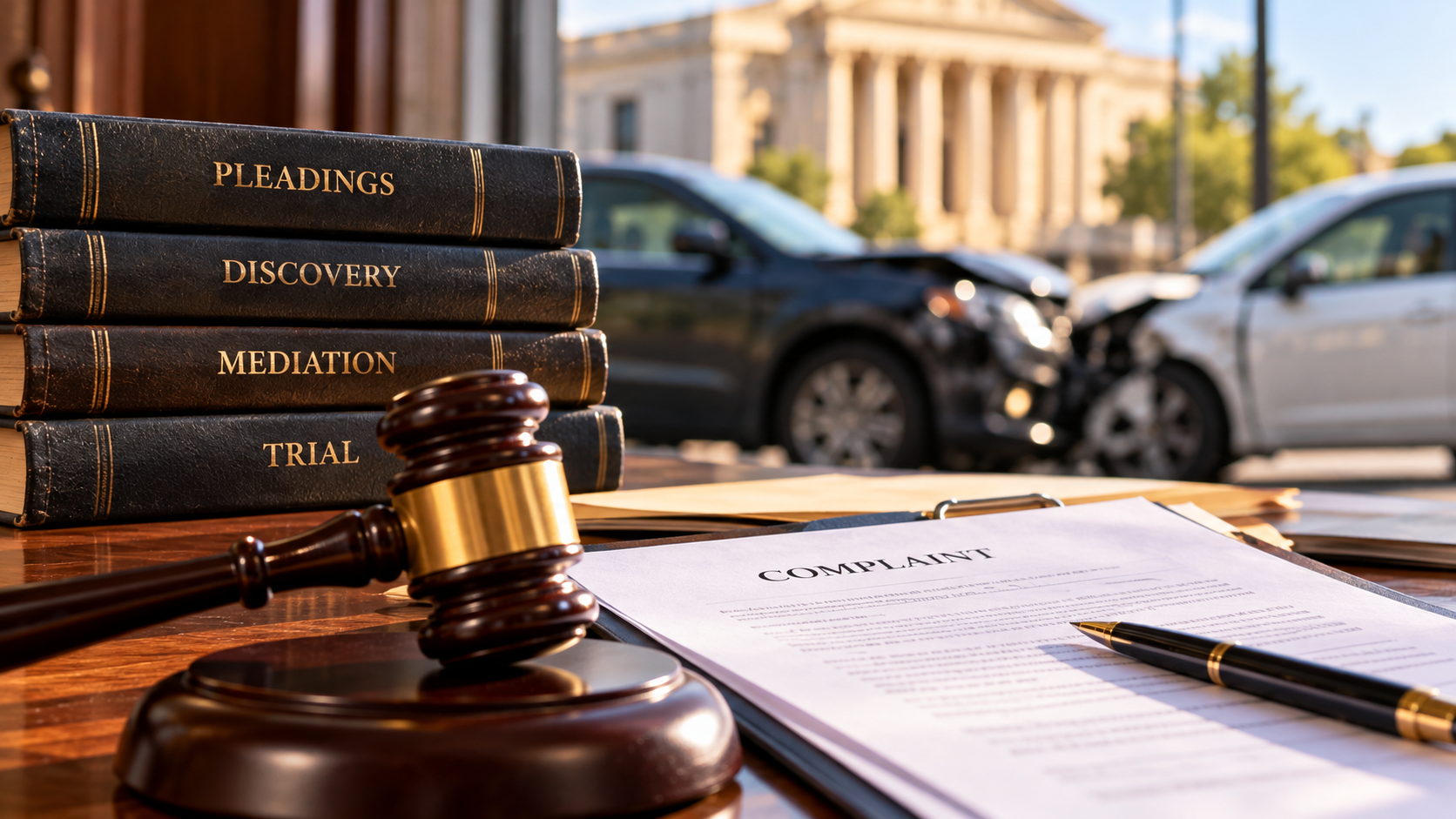
What Happens When You File a Car Wreck Lawsuit in Alabama?
Most people injured in an Alabama car wreck would prefer to settle their claim without going to court. They want their medical bills paid, compensation for their lost income, and an opportunity to move forward with their lives, and honestly-most claims do settle.
But what happens when the insurance company refuses to make a reasonable settlement offer?
Perhaps the adjuster agrees that the other driver caused the collision but disputes the seriousness of your injuries. Maybe the insurance company claims you were partly responsible for the wreck. Or perhaps your doctors believe you will need additional treatment, while the insurer insists that you have already recovered.
When those disagreements cannot be resolved through negotiation, filing a lawsuit may be necessary.
Filing a car wreck lawsuit does not mean you will automatically go to trial (again, most claims do settle). It begins a legal process that allows both sides to investigate the claims, obtain evidence, and ultimately present unresolved disputes to a judge or jury.
Understanding that process can make the decision to pursue a lawsuit considerably less intimidating.
Why Would I Need to File a Lawsuit After a Car Wreck?
Many automobile accident claims are resolved through negotiations with the insurance company. An attorney investigates the collision, gathers medical records, evaluates the client’s losses, and attempts to negotiate an appropriate settlement, but an insurance company is not required to accept the injured person’s assessment of the case.
Consider a construction worker who suffers a serious back injury when another driver runs a red light. After months of treatment, the worker’s physician determines that permanent lifting restrictions will prevent a return to construction.
The insurance company may agree to pay the emergency-room bills and a portion of the lost wages but refuse to compensate the worker for the long-term loss of earning capacity. At that point, filing a lawsuit may be the only practical way to pursue the full claim.
The same problem can arise when the insurer disputes whether the accident caused an injury. We address that issue in “The Insurance Company Says the Car Wreck Didn’t Cause My Injury. How Do I Prove It Did?” Medical testimony and evidence of the injured person’s condition before and after the collision may become particularly important.
Sometimes a lawsuit is also necessary because the statute of limitations is approaching. As we explain in “How Long Do I Have to File a Car Wreck Lawsuit in Alabama?”, most Alabama personal-injury claims must be filed within two years, and ongoing insurance negotiations ordinarily do not stop that deadline.
What Happens After My Attorney Files the Lawsuit?
A lawsuit generally begins when your attorney files a document called a complaint in the appropriate court. The complaint identifies the parties, describes the legal claims, and requests relief. In a typical automobile accident case, it may allege that the defendant negligently operated a vehicle and caused injuries and damages.
The defendant must then be formally notified through a procedure called service of process. Under Rule 12(a) of the Alabama Rules of Civil Procedure, a defendant ordinarily has thirty days after service to file an answer, although certain motions and other circumstances can change the response deadline.
The answer may deny responsibility, dispute the injuries, or raise legal defenses.
One defense that frequently matters in Alabama automobile cases is contributory negligence. The insurance company may argue that even though its insured driver was negligent, the injured person also failed to exercise reasonable care and contributed to the collision. Because Alabama generally follows a contributory-negligence rule, this defense can have serious consequences.
For example, an insurer might contend that its driver was speeding but that the injured person improperly entered the intersection. Whether that allegation is supported by the evidence may become a central issue in the lawsuit. The filing of the complaint does not resolve these disagreements. It establishes the legal proceeding in which they can be investigated and decided.
What Is Discovery, and Will I Have to Give a Deposition?
After the lawsuit begins, the parties ordinarily exchange information through a process called discovery.
Discovery allows each side to request relevant documents, ask written questions, and obtain testimony before trial. The purpose is to determine what the evidence actually shows rather than leaving everyone to rely on competing allegations.
In a serious car wreck case, discovery may involve medical records, employment information, photographs, witness statements, vehicle records, and other evidence concerning the collision and its consequences.
One part of discovery that often concerns clients is the deposition. A deposition is testimony given under oath, usually outside the courtroom, with the questions and answers recorded by a court reporter. The defense attorney may ask about how the collision occurred, your medical history, treatment, employment, and the ways your injuries have affected your life.
For example, if you claim that a back injury prevents you from returning to work, the defense attorney may ask about earlier back problems, your former job duties, and your current physical activities. Those questions can feel personal, but they are often directed toward issues the insurance company intends to dispute.
Your attorney should explain the deposition process beforehand, help you understand the subjects likely to arise, and attend the deposition to protect your legal interests.
The most important thing is to listen carefully, answer truthfully, and avoid guessing when you do not know or remember something.
Will I Have to Go to Mediation Before Trial?
Many Alabama personal-injury lawsuits involve mediation before trial. Mediation is a settlement conference conducted with the assistance of a neutral third party, called a mediator. The mediator helps the parties evaluate their positions and explore whether an agreement can be reached.
Under Ala. Code § 6-6-20, mediation may be required by agreement, upon a party’s motion, or by court order.
Suppose the injured person believes a claim is worth substantially more than the insurance company has offered. By the time mediation occurs, both sides may have obtained medical testimony, reviewed employment records, and examined the evidence concerning fault. That additional information may help narrow their disagreement.
Unlike arbitration, a judge or jury, however, a mediator cannot force the parties to accept a settlement. The decision whether to resolve the claim remains with the parties.
If an acceptable agreement is reached, the lawsuit can generally be concluded without a trial. If mediation is unsuccessful, the case can continue toward trial.
What Happens If My Car Wreck Case Goes to Trial?
If the parties cannot reach a settlement, the disputed issues may ultimately be presented to a jury.
At trial, the attorneys present evidence through witnesses, documents, photographs, medical testimony, and other admissible materials. The jury may be asked to decide whether the defendant was negligent, whether that negligence caused the plaintiff’s injuries, and what damages should be awarded. The jury may also have to consider contributory negligence.
The Alabama Supreme Court discussed the importance of that distinction in Hannah v. Gregg, Bland & Berry, Inc., 840 So. 2d 839, 860–61 (Ala. 2002). Although the case involved an industrial accident rather than an automobile collision, the Court explained that contributory negligence is ordinarily a question for the jury. The Court also emphasized that a defendant seeking summary judgment based on contributory negligence must meet a demanding standard when asking the court to decide that defense without a trial.
The principle matters in automobile litigation because the insurance company’s assertion that an injured driver was partly at fault does not, by itself, establish contributory negligence.
If the jury finds in favor of the injured person, it may award damages supported by the evidence and permitted by Alabama law. Those damages can include medical expenses, lost earnings, diminished earning capacity, pain and suffering, and other compensable losses.
Our article “Can I Recover Lost Wages If a Car Wreck Keeps Me From Working in Alabama?” explains why a permanent reduction in earning capacity can be considerably more significant than the wages missed during the initial recovery period.
A trial can also end with a verdict for the defendant. Filing a lawsuit provides an opportunity to prove a claim, not a guarantee of recovery.
How Long Does an Alabama Car Wreck Lawsuit Take?
There is no single timetable. A case involving relatively straightforward injuries and undisputed liability may resolve much sooner than one involving multiple defendants, permanent disability, complicated medical evidence, or a serious dispute over fault.
Court schedules, discovery disputes, expert testimony, and the availability of witnesses can also affect the time required.
Even after a lawsuit is filed, settlement negotiations may continue. Cases can resolve during discovery, at mediation, shortly before trial, or sometimes during trial itself.
The important point is that filing a lawsuit does not eliminate the possibility of settlement. In many situations, the litigation process provides the information necessary for both sides to evaluate the claim more realistically.
Will I Have to Pay Court Costs and Attorney Fees?
Personal-injury attorneys commonly handle automobile accident cases under a contingency-fee agreement, meaning the attorney’s fee depends on obtaining a recovery; however, the fee percentage, responsibility for litigation expenses, and treatment of costs if there is no recovery are governed by the particular agreement.
Filing fees, depositions, medical-record expenses, and expert-witness fees can become significant in contested cases, so before filing suit, clients should understand their fee agreement and how litigation expenses will be handled.
Filing a Lawsuit Is Sometimes Necessary to Protect Your Rights
Most people do not want to become involved in litigation after a serious car wreck. They want fair compensation and the ability to move forward. Unfortunately, insurance companies and injured people do not always agree about fault, medical causation, or the financial consequences of an injury.
When negotiations fail, a lawsuit provides a formal process for obtaining evidence, testing the parties’ positions, and seeking a resolution through settlement or trial.
The decision to file a lawsuit should be based on the facts, the available evidence, the applicable law, and the client’s circumstances—not simply the insurance company’s willingness to make an offer.
Talk With Powell & Denny About Your Alabama Car Wreck Claim
If you have been seriously injured in an Alabama automobile accident and the insurance company refuses to offer fair compensation, you may need to consider filing a lawsuit. If you have questions about bringing a claim, don’t hesitate to contact and speak with one of the experienced Alabama Car Wreck attorneys at Powell and Denny today for a free consultation. Appointments are available in person, or virtually via Zoom if more convenient. Powell and Denny would appreciate the opportunity to help. And remember, there is no fee unless you win.
Powell & Denny: We Work When You Can’t.
We Wrote the Book
My Alabama Disability Claim by William Powell & Gregory Denny Click Here to Get Your Free Copy


-
 5.0/5.0
A++++++ got results and staff is friendly
-
5.0/5.0
A++++++ got results and staff is friendly
-
5.0/5.0
Persevering for 2-3 years to get my disability. Thank You.
-
5.0/5.0
Persevering for 2-3 years to get my disability. Thank You.
-
 5.0/5.0
William Powell is an excellent attorney and a leader in our local bar.
