
What Does “Light Work” Really Mean?
Why Being Limited to Light Duty Can Decide Both an Alabama Workers’ Compensation Claim and a Social Security Disability Case
Many injured workers leave their doctor’s office relieved after hearing: “I’m releasing you to light duty.”
It sounds encouraging; but unfortunately, many people—including employers—misunderstand what light work actually means.
Light work does not mean “easy work.”
It does not mean you simply avoid heavy lifting.
And it certainly does not mean you are capable of performing every job that sounds “light.”
In both Alabama Workers’ Compensation and Social Security Disability cases, the definition of light work is surprisingly demanding. In fact, many injured workers who are told they can perform light work later discover they cannot meet the physical requirements of those jobs on a sustained basis.
Understanding exactly what light work requires is often critical in determining whether you can return to your previous job, whether you have suffered a loss of earning capacity, and whether you may qualify for Social Security Disability benefits.
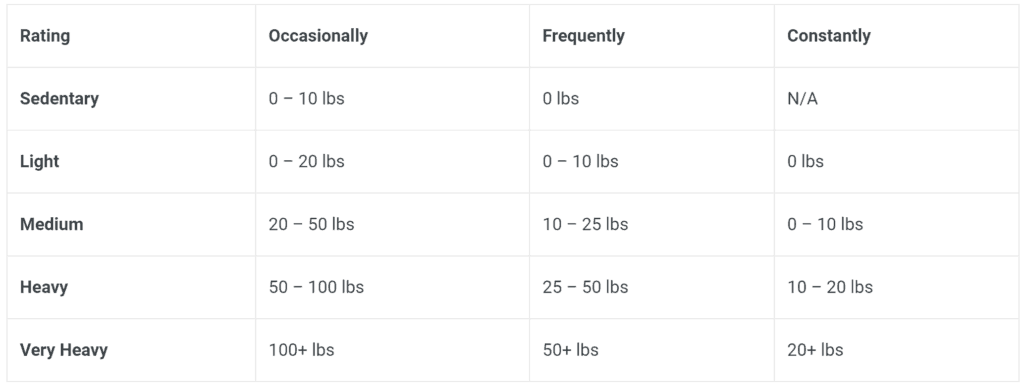
Recommended Reading: What Do Sedentary, Light, Medium, Heavy, and Very Heavy Work Really Mean?
How Does Social Security Define Light Work?
The Social Security Administration defines light work through:
Light work generally involves:
- lifting no more than 20 pounds occasionally;
- lifting or carrying up to 10 pounds frequently;
- standing or walking approximately 6 hours during an 8-hour workday;
- occasional stooping;
- frequent grasping, holding, and turning objects.
Perhaps the biggest surprise is this:
The lifting requirement is often not the hardest part.
For many injured workers, the requirement that they stand or walk approximately six hours each workday becomes the greatest obstacle.
Six Hours on Your Feet Is More Difficult Than Many People Realize
Most light jobs require workers to remain on their feet for the majority of the workday.
Examples include:
- retail sales;
- warehouse work;
- nursing assistants;
- food service;
- delivery positions;
- security jobs;
- production work;
- maintenance positions.
A worker suffering from:
- chronic back pain;
- knee arthritis;
- hip injuries;
- foot injuries;
- CRPS;
- altered gait;
- balance problems; or
- severe fatigue
may simply be unable to remain on their feet for six hours every day.
That limitation alone can eliminate a tremendous number of occupations.
Recommended Reading: How an Altered Gait Can Affect Both Alabama Workers’ Compensation and Social Security Disability Claims
Light Work Requires More Than Standing
Social Security also assumes a person performing light work can frequently:
- carry objects;
- grasp tools;
- push;
- pull;
- reach;
- bend occasionally;
- maintain pace throughout the day.
Many injuries interfere with these basic activities. For example:
A worker recovering from a torn rotator cuff may technically lift twenty pounds but be unable to repeatedly reach overhead.
A construction worker with chronic back pain may be able to lift twenty pounds once but not dozens of times throughout an eight-hour shift.
Someone suffering from permanent nerve damage may lose grip strength even though they retain adequate lifting ability.
The question is never simply: “How much can you lift?”
Instead, the question becomes: “Can you safely perform the entire range of activities required by light work, eight hours a day, five days a week?”
Recommended Reading: Why Grip Strength Matters in Workers’ Compensation and Social Security Disability Claims
You Must Be Able to Perform the Full Range of Light Work
This is one of the most misunderstood principles in disability law. Suppose a physician says:
- lift twenty pounds;
- no repetitive overhead reaching;
- alternate sitting and standing every fifteen minutes;
- no climbing;
- occasional stooping only;
- avoid uneven surfaces.
Although each restriction may appear modest, together they may eliminate a substantial number of light occupations.
That is because Social Security evaluates whether a claimant can perform the full range of an exertional category before applying the Medical-Vocational Guidelines.
When additional postural, manipulative, environmental, or positional limitations exist, the occupational base may be significantly reduced.
Recommended Reading: How Postural Restrictions Affect Alabama Workers’ Compensation and Social Security Disability Claims
Light Work and Alabama Workers’ Compensation
The phrase “light duty” also appears constantly in workers’ compensation cases. After an injury, the authorized treating physician may release the worker to:
- light-duty work;
- restricted duty;
- modified duty.
That does not necessarily mean the worker can return to the job they performed before the accident. Consider:
A 57-year-old pipefitter.
A 59-year-old welder.
A 61-year-old heavy equipment mechanic.
If each receives permanent restrictions limiting them to light work, they may never again be able to perform the heavy or very heavy occupations they spent decades learning.
For scheduled injuries that are properly taken outside the schedule—and for non-scheduled injuries—the court may then consider:
- age;
- education;
- vocational experience;
- transferable skills;
- permanent restrictions;
- ability to obtain reasonably suitable employment;
- ability to earn wages similar to those earned before the injury.
These vocational issues frequently become the heart of the workers’ compensation case.
Recommended Reading: What Happens If I Can’t Return to My Job After a Work Injury? Workers’ Compensation and Social Security Disability Explained
Recommended Reading: How Age Affects your Workers’ Comp and Disability Claims
Recommended Reading: What is “Reasonably Suitable Employment?”
Light Work and the Grid Rules
Being limited to light work affects different people differently.
A forty-year-old accountant may continue working with relatively little vocational impact.
A sixty-year-old laborer with no transferable skills may face an entirely different situation.
Under the Medical-Vocational Guidelines, age, education, previous work, transferable skills, and residual functional capacity all interact.
Sometimes a limitation to light work results in a finding of “not disabled.” At other times—particularly when additional restrictions exist—it becomes an important step toward proving disability.
This is why vocational evidence matters just as much as medical evidence.
Recommended Reading: Understanding the Medical-Vocational Grid Rules
Recommended Reading: I Can’t Do My Old Job Anymore. Why Does Social Security Think I Can Do Another One? Understanding Transferable Skills
Functional Capacity Evaluations Frequently Determine Light Work Restrictions
Many injured workers undergo a Functional Capacity Evaluation (FCE) before being assigned permanent work restrictions.
The evaluator may conclude the worker is capable of:
- Medium work;
- Light work; or
- Sedentary work.
Those conclusions often influence:
- permanent restrictions;
- settlement value;
- vocational opinions;
- return-to-work decisions; and
- later Social Security Disability claims.
An FCE, however, represents only one piece of evidence.
The treating physician’s opinions, imaging studies, objective medical findings, and the worker’s day-to-day functional abilities remain critically important.
Recommended Reading: What Is a Functional Capacity Evaluation (FCE), and How Does It Affect My Workers’ Compensation Case?
Sometimes “Light Work” Is Not Really Light Work
Many occupations classified as light work still require workers to:
- stand nearly all day;
- repeatedly bend;
- carry merchandise;
- push carts;
- reach overhead;
- stock shelves;
- move equipment;
- maintain production quotas.
For someone living with chronic pain, permanent nerve damage, CRPS, severe arthritis, or medication side effects, those requirements may simply be unrealistic.
That is why vocational testimony often becomes necessary in both workers’ compensation and Social Security Disability cases.
Recommended Reading: What is the Role of a Vocational Expert in my Claim?
The Bottom Line
Light work involves much more than lifting twenty pounds.
Under Social Security’s regulations, it generally requires standing or walking for approximately six hours during the workday, frequent use of the hands, occasional stooping, and the ability to sustain those activities on a regular and continuing basis.
In Alabama workers’ compensation cases, a permanent restriction to light work may prevent an injured worker from returning to the occupation they performed before their injury. When that occurs, vocational factors such as age, education, transferable skills, and loss of earning capacity often become central issues.
Understanding what “light work” actually requires—and whether you can realistically perform the full range of light work—is often one of the most important questions in both workers’ compensation and Social Security Disability claims.
At Powell & Denny, we have represented injured and disabled workers throughout Alabama for more than 30 years. We understand that serious claims are rarely decided by lifting restrictions alone. They are decided by how the injury affects the person’s ability to function, work, and earn a living.
If you have questions about an Alabama Workers’ Compensation claim, or a claim for Social Security Disability benefits, don’t hesitate to contact the experienced attorneys at Powell and Denny today a free consultation; remember. Virtual appointments are available through Zoom so you can meet with one of the attorneys of Powell and Denny from wherever you live, and remember-there is no fee unless you win.
Powell & Denny: We Work When You Can’t.
Offices in Birmingham, Alabama and Huntsville, AL
Next in this Series: What Does “Medium Work” Really Mean? Why Losing the Ability to Perform Medium Work Ends Many Careers
We Wrote the Book
My Alabama Disability Claim by William Powell & Gregory Denny Click Here to Get Your Free Copy


-
 5.0/5.0
A++++++ got results and staff is friendly
-
5.0/5.0
A++++++ got results and staff is friendly
-
5.0/5.0
Persevering for 2-3 years to get my disability. Thank You.
-
5.0/5.0
Persevering for 2-3 years to get my disability. Thank You.
-
 5.0/5.0
William Powell is an excellent attorney and a leader in our local bar.
