
What Do Sedentary, Light, Medium, Heavy and Very Heavy Work Really Mean?
Why These Five Words Can Determine the Outcome of an Alabama Workers’ Compensation or Social Security Disability Claim
One of the most important questions asked in almost every Alabama Workers’ Compensation case and Social Security Disability claim is surprisingly simple:
“What level of work can this person still perform?”
Most people assume the answer depends only on how much weight they can lift.
It doesn’t.
In reality, the difference between Sedentary, Light, Medium, Heavy, and Very Heavy work involves far more than lifting. It includes how long you can stand or walk, how often you can bend, whether you can use your hands throughout the day, whether you can climb, kneel, crouch, reach overhead, and dozens of other physical abilities.
A seemingly small permanent restriction may reduce a worker from Medium work to Light work, or from Light work to Sedentary work. Sometimes, that single change can dramatically affect both a workers’ compensation case and a Social Security Disability claim.
Why Do These Work Classifications Matter?
Doctors use them.
Physical therapists use them.
Functional Capacity Evaluations (FCEs) use them.
Vocational experts rely on them.
Administrative Law Judges use them.
Trial courts consider them.
In other words, these work classifications often become the common language used to describe what an injured worker can—and cannot—do after an injury.
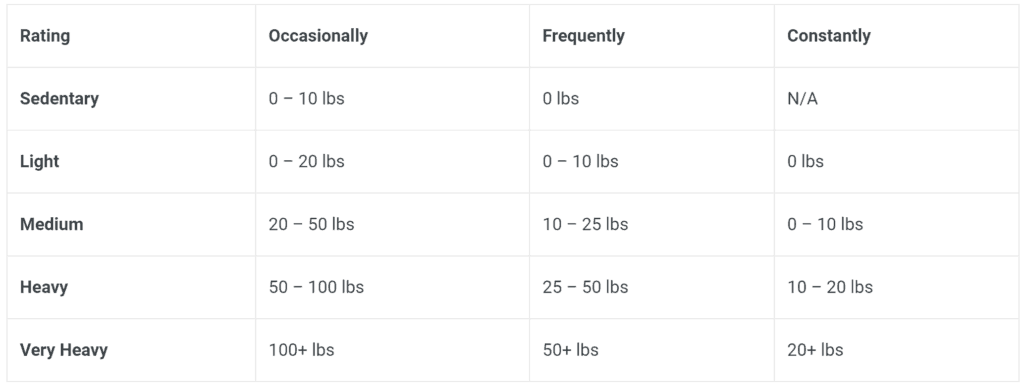
The Five Exertional Levels
|
||||||||||||||||||||||||||||||||||||
The key point: These classifications require the ability to perform the full range of activities associated with each level—not just meet the lifting requirement.
Why a Small Restriction Can Have Big Consequences
Imagine a warehouse employee who previously performed medium work. Following a shoulder injury, the doctor permanently limits the worker to:
- lifting no more than 20 pounds,
- only occasional overhead reaching, and
- no frequent pushing or pulling.
That worker has likely moved from Medium work to Light work.
Now imagine the worker also develops knee problems and can stand only four hours a day. They may no longer be capable of Light work, leaving only Sedentary work.
Each step down the exertional ladder can significantly affect both workers’ compensation benefits and Social Security Disability eligibility.
Recommended Reading: What Do Permanent Work Restrictions Mean in Workers’ Compensation and Social Security Disability Cases?
Workers’ Compensation and Work Classifications
In Alabama workers’ compensation cases, these work levels help answer questions such as:
- Can the worker return to their former job?
- Has the worker suffered a loss of earning capacity?
- Are vocational disability benefits available?
- Has a scheduled injury affected the body as a whole?
- Can the worker find reasonably suitable employment at similar remuneration?
For example, a construction worker restricted to sedentary work may have virtually no ability to return to the type of work they have performed throughout their career.
Recommended Reading: What Happens If I Can’t Return to My Job After a Work Injury? Workers’ Compensation and Social Security Disability Explained
Social Security Disability Uses These Same Classifications
The Social Security Administration also evaluates what level of work a claimant can perform.
Once Social Security determines a person’s Residual Functional Capacity (RFC), it asks:
- Can the claimant return to past relevant work?
- If not, can they perform other work existing in significant numbers in the national economy?
Age, education, transferable skills, and these work classifications often become the deciding factors.
For older workers, dropping from Medium work to Light—or from Light to Sedentary—can sometimes make the difference between approval and denial under the Medical-Vocational Guidelines (the “Grid Rules”).
Recommended Reading: What Does “Jobs Existing in Significant Numbers” Really Mean in a Social Security Disability Case?
Recommended Reading: What is My Residual Functional Capacity (RFC)?
Recommended Reading: What are the Grid Rules?
One Restriction Rarely Stands Alone
Most serious injuries involve more than one limitation.
A worker with a back injury may also have:
- lifting restrictions;
- postural limitations;
- chronic pain;
- medication side effects;
- difficulty standing;
- reduced grip strength; or
- problems using both hands.
Individually, each limitation may seem modest. Together, they can substantially reduce the range of jobs a person can perform.
That is why physicians, vocational experts, and judges look at the combined effect of all permanent restrictions—not just one in isolation.
Recommended Reading: How Postural Restrictions Affect Alabama Workers’ Compensation and Social Security Disability Claims
This Series Will Explore Each Work Level in Detail
Over the next several articles, we’ll examine each exertional level individually, including:
- What Does “Sedentary Work” Really Mean?
- What Does “Light Work” Really Mean?
- What Does “Medium Work” Really Mean?
- What Does “Heavy Work” Really Mean?
- What Does “Very Heavy Work” Really Mean?
We’ll explain not only the official definitions, but also why these classifications matter in real-world workers’ compensation and disability cases—and how permanent restrictions can move a worker from one level to another.
The Bottom Line
The terms Sedentary, Light, Medium, Heavy, and Very Heavy work may sound like simple descriptions of physical labor, but they are actually legal and vocational classifications that can determine the outcome of both an Alabama workers’ compensation claim and a Social Security Disability case.
Understanding what these classifications really mean—and how injuries, chronic pain, permanent restrictions, and vocational factors affect them—is essential for anyone trying to understand their rights after a serious injury or illness.
Related Reading
If you’d like to learn more about how physical limitations affect workers’ compensation and Social Security Disability claims, you may also find these articles helpful:
- Why Grip Strength Matters in Workers’ Compensation and Social Security Disability Claims
- Can Pain Alone Keep Me from Working? Understanding Pain in Alabama Workers’ Compensation and Social Security Disability Claims
At Powell & Denny, we have represented injured and disabled workers throughout Alabama for more than 30 years. We understand that serious claims are rarely decided by lifting restrictions alone. They are decided by how the injury affects the person’s ability to function, work, and earn a living.
If you have questions about an Alabama Workers’ Compensation claim, or a claim for Social Security Disability benefits, don’t hesitate to contact the experienced attorneys at Powell and Denny today a free consultation; remember. Virtual appointments are available through Zoom so you can meet with one of the attorneys of Powell and Denny from wherever you live, and remember-there is no fee unless you win.
Powell & Denny: We Work When You Can’t.
Offices in Birmingham, Alabama and Huntsville, AL
We Wrote the Book
My Alabama Disability Claim by William Powell & Gregory Denny Click Here to Get Your Free Copy


-
 5.0/5.0
A++++++ got results and staff is friendly
-
5.0/5.0
A++++++ got results and staff is friendly
-
5.0/5.0
Persevering for 2-3 years to get my disability. Thank You.
-
5.0/5.0
Persevering for 2-3 years to get my disability. Thank You.
-
 5.0/5.0
William Powell is an excellent attorney and a leader in our local bar.
