
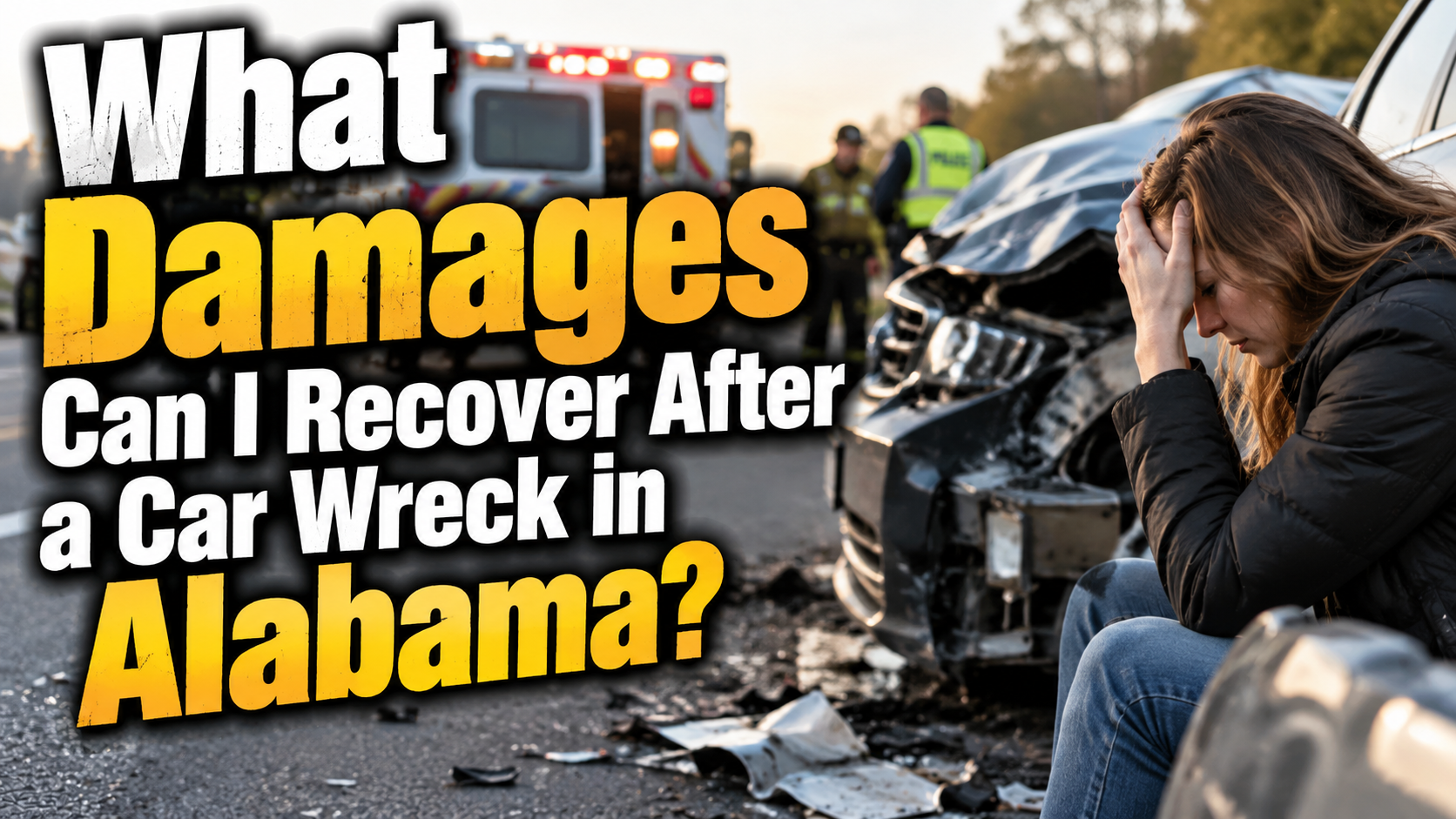
What Damages Can I Recover After a Car Wreck in Alabama?
If another driver causes a car wreck in Alabama, you may hear lawyers, insurance adjusters, and courts use the word “damages,” But what does that actually mean?
Damages are the losses for which Alabama law allows an injured person to seek monetary recovery from a legally responsible party. Depending on the circumstances, those losses may include much more than the medical bills sitting on your kitchen table.
An Alabama car wreck may result in claims for medical expenses, future medical treatment, lost wages, reduced future earning capacity, physical pain and suffering, mental anguish, permanent injury, disability, scarring or disfigurement, property damage, and—in appropriate cases—loss of consortium.
In more limited circumstances involving sufficiently wrongful conduct, punitive damages may also be available.
But not every person injured in a wreck can recover every type of damage. The damages must be legally recoverable, supported by the evidence, and caused by the defendant’s conduct. Understanding the different categories of damages is therefore an important part of understanding an Alabama car wreck claim.
What Are Compensatory Damages?
Most damages in an Alabama car wreck case are compensatory damages. The basic purpose is reflected in the name: they are intended to compensate the injured person for losses caused by the defendant.
Compensatory damages are often divided into two broad categories:
Economic damages involve financial losses that can often be documented with bills, wage records, or other financial evidence.
Noneconomic damages involve human losses that do not come with an invoice—such as physical pain, mental anguish, permanent impairment, or disfigurement.
An injured person may have both. A serious personal injury claim should therefore not be evaluated simply by adding up the medical bills.
Can I Recover My Medical Expenses?
Reasonable and necessary medical expenses caused by the wreck may be recoverable. These can potentially include expenses for things such as:
- ambulance transportation;
- emergency-room treatment;
- hospitalization;
- physician visits;
- physical therapy;
- diagnostic testing;
- surgery;
- injections;
- prescription medication;
- medical equipment; and
- other medically necessary treatment.
But simply producing a bill does not necessarily establish that the defendant owes it. The treatment must be connected to the injuries caused by the wreck, and the reasonableness and necessity of the expenses can become issues in the case.
The Alabama Supreme Court explained in Carnival Cruise Lines, Inc. v. Snoddy that recoverable medical expenses include reasonable expenses necessarily incurred for medical treatment and reasonable expenses for treatment reasonably certain to be required in the future.
That last part is important.
A car wreck claim can involve not only medical treatment that has already occurred, but also future medical treatment.
Can I Recover Future Medical Expenses?
Potentially, yes.
Suppose a wreck causes a serious back injury. You undergo physical therapy and injections, but your physician believes you will eventually require lumbar surgery. The fact that the surgery has not yet occurred does not necessarily mean its anticipated cost should be ignored.
As Snoddy explains, damages may include reasonable expenses for medical care, treatment, or services that the evidence establishes are reasonably certain to be required in the future.
Future medical damages therefore depend heavily upon the medical evidence. Questions may include:
What treatment has the doctor recommended?
How likely is it that the treatment will be necessary?
What will it cost?
Will additional treatment be required afterward?
Will medication or medical equipment be needed?
This is one reason settling a serious car wreck claim before the medical prognosis becomes reasonably clear can create problems.
Recommended Reading: The Insurance Company Offered Me a Settlement After My Car Wreck. Should I Take It?
What If Health Insurance Paid My Medical Bills?
This area of Alabama law is more complicated than simply saying, “Insurance paid it, so you cannot recover it.”
Alabama Code § 12-21-45 provides that when medical or hospital expenses are claimed in a civil action, evidence that those expenses have been or will be paid or reimbursed is admissible. The statute also permits the plaintiff to introduce evidence concerning the cost of obtaining that reimbursement or payment. If the plaintiff proves an obligation to repay the medical expenses that were paid or reimbursed, evidence relating to that reimbursement or payment is also admissible.
That can make medical-expense damages more complicated than simply totaling the amounts originally billed by the medical providers.
There may also be separate questions concerning health-insurance reimbursement rights, Medicare, Medicaid, hospital liens, or other claims against a settlement.
That leads to an important distinction:
The amount of damages and the amount the injured person ultimately receives from a settlement are not necessarily the same thing.
Can I Recover Lost Wages?
Yes, when the evidence establishes that the injury caused you to lose earnings. Suppose you earn $1,200 per week and your injuries prevent you from working for eight weeks. Those lost earnings may form part of your compensatory damages.
Employment records, payroll information, tax records, employer testimony, medical restrictions, and other evidence may be used to establish the loss, but in a serious injury case, past lost wages may be only part of the economic damage.
There is another question:
What if I can return to work, but I cannot earn what I could before the wreck?
Can I Recover for Loss of Future Earning Capacity?
Under appropriate circumstances, yes.
Alabama law distinguishes between lost earnings and impairment of earning capacity.
The Alabama Supreme Court explained the distinction in Carnival Cruise Lines, Inc. v. Snoddy. Lost earnings concern the value of work time already lost. Impairment of earning capacity concerns a reduction in the injured person’s ability to earn a living.
That distinction can be extremely important after a permanent injury.
Imagine a 40-year-old construction worker who earns $65,000 per year. A wreck causes a permanent lumbar injury. His doctor eventually allows him to return to work but restricts him from repetitive bending and from lifting more than 25 pounds.
He may have relatively little past wage loss if his employer accommodated him temporarily, but if those restrictions prevent him from returning to construction work, the larger economic loss may occur over the next 20 or 25 years.
Alabama law requires evidence connecting the physical impairment to the person’s diminished ability to earn. A permanent medical impairment, standing alone, does not automatically establish an equivalent percentage loss of earning capacity.
That is an important concept.
A doctor’s 10% impairment rating does not automatically mean a 10% loss of earning capacity. The effect of an injury depends in part upon what the person actually does for a living.
As the Alabama Supreme Court observed in Snoddy, the loss of a hand might have little effect on the earning capacity of one occupation while having devastating consequences for a surgeon, pianist, or construction worker.
In significant cases, vocational and economic evidence may therefore become important.
Can I Recover for a Permanent Injury Even If I Can Still Work?
Yes.
Permanent injury and loss of earning capacity are not the same type of damage.
This distinction is particularly important. A person can suffer a permanent physical injury without proving any reduction in future earning capacity.
In Snoddy, the Alabama Supreme Court specifically distinguished damages for impaired earning capacity from other compensable consequences of physical injury. The Court recognized that physical impairment may support other categories of damages even when it does not establish diminished earning capacity.
Suppose an accountant suffers a permanent knee injury. She returns to the same job at the same salary. She therefore may have difficulty establishing any significant loss of earning capacity.
But suppose she also has permanent pain, cannot kneel, cannot comfortably climb stairs, has difficulty walking long distances, and can no longer participate in activities she enjoyed before the wreck. The absence of lost future earnings does not make those consequences disappear.
Can I Recover for Physical Pain and Suffering?
Yes.
Physical pain and suffering can be an important component of compensatory damages after an injury. Unlike a hospital bill, however, pain does not come with a dollar amount attached to it.
There is no Alabama statute declaring that six months of back pain is worth a particular amount.
There is no legitimate rule that pain and suffering always equals two times, three times, or five times the medical bills.
The Alabama Supreme Court has expressly recognized that there is no fixed monetary standard for compensating physical pain and mental anguish. In Snoddy, the Court approved an instruction leaving reasonable compensation for those losses to the factfinder based upon the evidence.
Relevant evidence may include the nature and severity of the injury, duration of symptoms, treatment received, medication, limitations on daily activities, sleep disruption, and whether pain is expected to continue. That is one reason two people with identical medical bills can have very different damages.
What Is Mental Anguish?
Mental anguish addresses the emotional and psychological suffering associated with an injury. It can include substantially more than momentary frustration over having been involved in a wreck.
In physical-injury cases, Alabama law recognizes mental and emotional suffering accompanying the injury as a potential element of compensatory damages. In Wal-Mart Stores, Inc. v. Thompson, for example, the Alabama Supreme Court held that evidence of a serious and painful physical injury and its consequences supported an award for the mental and emotional suffering attending that injury.
Evidence might concern anxiety, fear, emotional distress, depression associated with chronic pain or disability, or other significant effects of the injury. And again, there is no fixed mathematical formula.
The nature, severity, and duration of the mental anguish matter.
What About Scarring or Disfigurement?
A permanent scar or disfigurement can represent a separate consequence of physical injury that should be considered when evaluating compensatory damages. Its significance can depend upon the particular facts.
A small surgical scar ordinarily presents a different issue from severe facial scarring caused by broken glass. Relevant considerations can include the scar’s location, size, visibility, permanence, associated pain or physical limitation, and its effect on the injured person.
The broader point is that the consequences of an injury are not limited to medical expenses and lost wages. A person may return to work and still live permanently with visible evidence of the wreck.
Can I Recover for Losing the Ability to Do Things I Enjoy?
The effect of an injury on a person’s ordinary life can be relevant evidence when evaluating pain, suffering, permanent injury, disability, and mental anguish.
Suppose someone previously:
played golf every weekend;
worked in a garden;
went hunting;
ran several times a week;
coached a child’s baseball team;
performed his own home repairs;
or regularly played with his grandchildren.
After a permanent injury, he can no longer do those things.
There is no invoice for that loss, but evidence concerning what the person could do before the wreck compared with what he can do afterward can help demonstrate the real-world consequences of the injury. That is why testimony from the injured person—and sometimes from a spouse, family member, coworker, or friend—can be important in a serious personal injury case.
Can My Spouse Recover Damages Because of My Injuries?
Potentially.
Alabama recognizes a spouse’s claim for loss of consortium. Loss of consortium generally concerns the loss or impairment of the marital relationship resulting from the injured spouse’s injuries, including aspects of companionship, affection, society, assistance, and marital relations.
It is a claim belonging to the uninjured spouse, although it arises from the injuries to the other spouse.
Alabama automobile cases have recognized consortium claims. For example, in Edwards v. Valentine, the Alabama Supreme Court affirmed an award to an injured motorist’s wife on her loss-of-consortium claim arising from an automobile collision.
Insurance coverage can create a separate issue. In Tate v. Allstate Insurance Co., another automobile case, the Alabama Supreme Court addressed how a spouse’s loss-of-consortium claim interacted with the liability policy’s per-person limit.
So, consortium can affect both the damages analysis and the insurance-coverage analysis.
Can I Recover for Damage to My Car?
Yes. Property damage is distinct from the personal-injury claim.
Alabama has long measured automobile property damage primarily by the difference between the vehicle’s value immediately before and immediately after the collision. Where the vehicle can be repaired, reasonable repair costs and related damages can become relevant. Alabama law has also recognized loss-of-use damages under appropriate circumstances.
Property-damage issues can include:
repair costs;
total-loss value;
towing;
storage;
loss of use or reasonable rental expenses where legally recoverable; and
other collision-related property losses supported by the evidence.
But property damage and bodily-injury damages remain separate questions. A vehicle can suffer catastrophic damage while its occupant fortunately escapes serious injury. Conversely, relatively modest visible vehicle damage does not by itself establish that an occupant could not have been injured.
Can I Recover Punitive Damages After an Alabama Car Wreck?
Sometimes, but punitive damages are fundamentally different from compensatory damages.
Compensatory damages address the plaintiff’s loss. Punitive damages are directed at sufficiently wrongful conduct by the defendant.
Alabama Code § 6-11-20 provides that punitive damages generally require clear and convincing evidence that the defendant consciously or deliberately engaged in oppression, fraud, wantonness, or malice. The statute defines wantonness as conduct carried on with reckless or conscious disregard for the rights or safety of others.
In a car wreck case, the relevant theory is often wantonness, but an important caution is necessary: Negligence is not automatically wantonness.
A driver can make a serious mistake and negligently cause a collision without the evidence satisfying Alabama’s higher standard for wanton conduct.
Likewise, the fact that a driver was speeding, distracted, or violated a traffic law does not automatically establish entitlement to punitive damages. The entire factual context matters.
Are Punitive Damages Limited in Alabama?
Generally, yes, although the statute contains important exceptions.
For civil actions involving physical injury, Alabama Code § 6-11-21(d) generally provides that a punitive-damages award may not exceed three times the compensatory damages or $1.5 million, whichever is greater, subject to the statute’s provisions, exceptions, and periodic adjustment mechanism. The statute expressly does not apply that limitation to wrongful-death actions or intentional infliction of physical injury.
Punitive damages therefore should not simply be added to every car wreck evaluation.
First, there must be a legal basis for them.
Second, the evidence must satisfy the applicable burden of proof.
Third, Alabama’s statutory and constitutional limitations on punitive awards must be considered.
What If Someone Dies in the Car Wreck?
This requires an important Alabama-specific distinction.
An Alabama wrongful-death claim is not simply a severe personal-injury claim in which the family recovers the deceased person’s medical bills, lost future wages, pain and suffering, and the monetary value of the person’s life.
Alabama’s wrongful-death law is unusual.
Under Alabama’s interpretation of Ala. Code § 6-5-410, damages in a wrongful-death action are punitive rather than compensatory. The focus is on the wrongfulness of the defendant’s conduct and the purposes of punishment and deterrence—not calculating the survivors’ economic loss or placing a compensatory value on the decedent’s life.
That makes Alabama wrongful-death law materially different from the law in many other states. A fatal car wreck therefore deserves a separate legal analysis rather than simply applying the damages categories discussed in the rest of this article.
Recommended Reading: My Family Member Was Killed in an Alabama Car Wreck. Can I File a Wrongful Death Claim?
Does Contributory Negligence Affect My Damages?
It can do something much more significant than merely reduce them.
Alabama follows the doctrine of contributory negligence in ordinary negligence cases.
Unlike comparative-fault jurisdictions, Alabama does not ordinarily reduce a negligence recovery by the plaintiff’s percentage of fault. Instead, contributory negligence can operate as a complete defense to an ordinary negligence claim.
So, a person might establish substantial medical expenses, lost earnings, permanent disability, and pain and suffering—but still face a complete bar to recovery on the negligence claim if the defendant proves the elements of contributory negligence.
That is why damages cannot be evaluated in isolation from liability.
Recommended Reading: The Insurance Company Says the Car Wreck Was Partly My Fault. Can I Still Recover in Alabama?
Is Contributory Negligence a Defense to Wantonness?
No.
Alabama distinguishes negligence from wantonness, and contributory negligence is not a defense to a properly established wantonness claim, but that does not mean pleading the word “wantonness” allows every plaintiff to avoid contributory negligence.
The evidence still has to support the wantonness claim, and punitive damages require the heightened showing imposed by § 6-11-20.
What Is the Difference Between Damages and What I Can Actually Recover?
This may be the most important distinction in the article.
Damages measure the losses Alabama law recognizes.
Recovery is the money that can actually be obtained from the responsible parties and available insurance.
Those numbers may be very different.
Imagine a person suffers catastrophic injuries producing legally provable damages of $750,000.
The at-fault driver has only $25,000 in bodily-injury liability coverage and no meaningful personal assets.
The damages do not suddenly become $25,000. The problem is collectability.
That is why identifying all available insurance can be crucial in a serious Alabama car wreck case. There may be liability coverage from more than one source. Depending upon the circumstances, uninsured or underinsured motorist coverage may also be available.
Recommended Reading: What Is Uninsured and Underinsured Motorist Coverage in Alabama?
Recommended Reading: What If the Driver Who Hit Me Doesn’t Have Enough Insurance to Pay My Damages?
How Are Damages Proven?
A person does not recover damages merely by listing them in a lawsuit; the losses must be supported by evidence.
Depending upon the particular category of damage, that evidence may include medical records, medical bills, diagnostic studies, physician testimony, photographs, employment records, wage statements, tax records, vocational evidence, economic testimony, vehicle-repair records, and testimony from the injured person and others who have observed how the injury changed the person’s life.
Why Doesn’t Alabama Just Use a Formula?
Because injuries affect people differently. Consider two people with the same lumbar injury.
One works from home at a computer, responds well to treatment, and returns to full activity. The other is a heavy-equipment mechanic who must repeatedly lift, bend, crawl, climb, and work in awkward positions. He develops permanent restrictions that prevent him from returning to the occupation he has performed for 25 years.
The diagnosis might be the same. The MRI might look similar. The impairment ratings might even be identical.
But the consequences of the injury are not identical.
That is precisely why Alabama law distinguishes physical impairment from impaired earning capacity and why noneconomic damages such as pain and suffering cannot be reduced to a simple multiplier.
What Damages Can I Recover After an Alabama Car Wreck?
Depending upon the facts and evidence, an Alabama car wreck claim may potentially involve compensation for:
past medical expenses;
future medical expenses;
past lost earnings;
loss or impairment of future earning capacity;
physical pain and suffering;
mental anguish;
permanent injury and physical impairment;
scarring or disfigurement;
property damage and related losses;
and, where applicable, a spouse’s loss of consortium.
In cases involving sufficiently wrongful conduct, punitive damages may also be available.
But the existence of a category of damages does not mean it automatically applies to every claim. The evidence must establish the loss and connect it to the wreck.
At Powell & Denny, P.C., we evaluate serious Alabama car wreck claims by looking beyond the medical bills. We examine the medical evidence, lost income, future ability to work, permanent restrictions, pain and other consequences of the injury, available insurance coverage, and the evidence necessary to establish each recoverable loss.
If you have been injured in an Alabama car wreck and have questions about what damages may be available in your case — don’t hesitate to contact and speak with one of the experienced Alabama Car Wreck attorneys at Powell and Denny today for a free consultation. Appointments are available in person, or virtually via Zoom if more convenient. Powell and Denny would appreciate the opportunity to help. And remember, there is no fee unless you win.
Powell & Denny: We Work When You Can’t.
We Wrote the Book
My Alabama Disability Claim by William Powell & Gregory Denny Click Here to Get Your Free Copy


-
 5.0/5.0
A++++++ got results and staff is friendly
-
5.0/5.0
A++++++ got results and staff is friendly
-
5.0/5.0
Persevering for 2-3 years to get my disability. Thank You.
-
5.0/5.0
Persevering for 2-3 years to get my disability. Thank You.
-
 5.0/5.0
William Powell is an excellent attorney and a leader in our local bar.
