
Injured While Working in an Alabama Manufacturing Plant? Know Your Rights
Manufacturing workers help keep Alabama’s economy moving. From automotive assembly plants and steel mills to poultry processing facilities and smaller machine shops, thousands of Alabamians spend their working days operating equipment, handling materials, and keeping production lines running.
But manufacturing work can also be dangerous.
A machine can catch a worker’s hand. A forklift can strike someone walking through a warehouse. Years of repetitive movements can damage the shoulders, wrists, or back. And a single accident can leave an experienced employee unable to return to the work they have performed for decades.
If you are injured while working in an Alabama manufacturing plant, you may be entitled to workers’ compensation benefits. In some circumstances, you may also have a separate claim against an equipment manufacturer or another responsible party.
Understanding those rights is especially important when the injury threatens your ability to earn a living.
What Are the Most Common Manufacturing Injuries?
Manufacturing injuries can occur suddenly or develop over time. Some of the injuries we see associated with industrial work include:
- Machine injuries: Crushed fingers, amputations, severe cuts, and injuries involving presses, conveyors, or other moving equipment.
- Forklift accidents: Workers struck by forklifts, pinned between equipment, or injured by falling loads.
- Back and shoulder injuries: Damage caused by lifting, pulling, pushing, or handling heavy materials.
- Repetitive-motion injuries: Carpal tunnel syndrome, tendon injuries, and other conditions associated with repeated physical movements.
- Falls: Injuries involving slippery floors, platforms, stairs, or elevated work areas.
- Chemical and respiratory injuries: Harm associated with certain workplace exposures.
Not every injury has the same legal requirements.
A worker whose hand is caught in a machine may have a straightforward traumatic-injury claim. An employee who develops carpal tunnel syndrome after years of repetitive work may face a more complicated dispute over whether the job caused the condition.
Can I Receive Workers’ Compensation If Nobody Was at Fault?
Generally, yes.
Alabama workers’ compensation is primarily a no-fault system. An employee ordinarily does not have to prove that the employer was negligent to obtain benefits for a covered workplace injury.
For example, suppose an assembly-line worker injures a shoulder while lifting a heavy component during a normal shift. The employee may have a compensable injury even if the employer followed its safety procedures and no coworker did anything wrong.
The central issues generally involve whether the injury arose out of and occurred in the course of covered employment and whether the required medical connection can be established.
In Ex parte Trinity Industries, Inc., 680 So. 2d 262, 266–69 (Ala. 1996), the Alabama Supreme Court discussed the importance of establishing legal and medical causation in workers’ compensation claims, particularly those involving injuries not caused by an obvious traumatic event.
The fact that an injury occurs at work is important, but it does not automatically establish that every medical condition is work-related.
Recommended readings: Alabama Workers Comp Questions: (1) Do I have a Claim?
What Is Medical Causation and Why Does It Matter in an Alabama Workers Compensation Claim?
What If My Injury Developed Gradually?
Many manufacturing employees perform the same movements hundreds of times during a shift. A worker may repeatedly lift parts onto a conveyor, operate a hand tool, or reach overhead to assemble products.
Over months or years, those movements may contribute to physical problems.
Alabama workers’ compensation law recognizes certain cumulative-trauma injuries, including carpal tunnel syndrome; however, these claims have an important evidentiary distinction. Under Ala. Code § 25-5-81(c), injuries resulting from gradual deterioration or cumulative physical stress disorders must be established by clear and convincing evidence that they arose out of and in the course of employment.
That is a higher burden of proof than the ordinary preponderance-of-the-evidence standard.
Medical records, a detailed description of job duties, and evidence concerning the frequency and physical demands of the work can be particularly important. For example, an employee who develops wrist problems after operating a repetitive assembly process may need evidence connecting those activities to the diagnosed condition.
The employer or insurance company may argue that age, arthritis, diabetes, or activities outside work caused the symptoms, but those disputes should be evaluated using the medical evidence and the employee’s actual work history.
Recommend reading: Repetitive Use Injuries: When Years of Doing the Same Job Become a Disability
What Benefits Can an Injured Manufacturing Worker Receive?
Depending on the circumstances, Alabama workers’ compensation may provide:
Medical treatment. Reasonably necessary medical care related to a compensable injury is generally covered under Ala. Code § 25-5-77. The employer or its insurance carrier ordinarily has an important role in selecting the authorized treating physician.
Temporary disability benefits. If the injury prevents the employee from working during recovery, qualifying temporary disability benefits may be available, subject to statutory requirements and waiting periods.
Permanent partial disability benefits. A worker who reaches maximum medical improvement but retains permanent limitations may qualify for benefits under the applicable statutory provisions.
Permanent total disability benefits. If the injury permanently prevents the employee from performing the former trade and obtaining other reasonably gainful employment, permanent total disability benefits may be appropriate.
The type and amount of benefits depend on the injury, medical findings, wages, and applicable Alabama law.
Recommended Readings: How Do I Get Paid While I am Off Work? Understanding Alabama Workers Compensation Benefits
What If I Cannot Return to My Manufacturing Job?
This can be one of the most difficult consequences of a serious industrial injury. Consider a 55-year-old employee who has spent thirty years operating heavy machinery.
After a workplace accident, the employee undergoes back surgery and receives permanent restrictions against heavy lifting, bending, and prolonged standing. The employer may not have a position that accommodates those restrictions. The worker may still be capable of some physical activities, but that does not necessarily mean suitable employment is realistically available.
Alabama courts recognize that permanent total disability does not require absolute physical helplessness.
In Mead Paper Co. v. Brizendine, 575 So. 2d 571, 574–75 (Ala. Civ. App. 1990), the Court of Civil Appeals addressed the relationship between an employee’s inability to perform the former trade and the ability to obtain other reasonably gainful employment, including through retraining.
An employee’s education, experience, physical limitations, and realistic employment prospects may all become relevant.
We discuss the broader financial consequences of permanent work restrictions in our related article, “What If My Injuries Permanently Prevent Me From Working After an Alabama Car Wreck?” Although that article begins with automobile injuries, the distinctions among workers’ compensation, earning capacity, and Social Security Disability are also important to manufacturing workers.
Recommended Reading: What Happens If I Can’t Return to My Job After a Work Injury? Workers Compensation and Social Security Disability Explained
What If a Defective Machine Caused My Injury?
Some manufacturing accidents involve more than an ordinary workplace injury. Suppose a machine unexpectedly activates while an employee is clearing material from the production area.
Or a piece of equipment malfunctions because of an alleged defect in its design or manufacturing.
The injured worker may have a workers’ compensation claim against the employer, but there may also be a potential product-liability claim against a separate company responsible for the defective equipment.
Alabama recognizes product-liability claims under the Alabama Extended Manufacturer’s Liability Doctrine, commonly called the AEMLD, along with other potentially applicable theories. A successful claim requires proof of the relevant legal elements. The fact that a machine caused an injury does not, by itself, establish that the machine was defective.
The equipment’s design, warnings, maintenance history, modifications, and condition at the time of the accident may become important.
Preserving the machine and its components can be critical. If the equipment is repaired, modified, or discarded before an investigation, valuable evidence may be lost.
Can I Bring a Personal Injury Claim If a Machine’s Safety Guard Was Removed?
When a manufacturing worker suffers a serious injury because a machine’s safety guard was removed, disabled, or bypassed, workers’ compensation may not be the only available remedy. Under certain circumstances, Alabama law allows the injured employee to pursue a separate personal injury claim based on the intentional removal of a machine’s safety device.
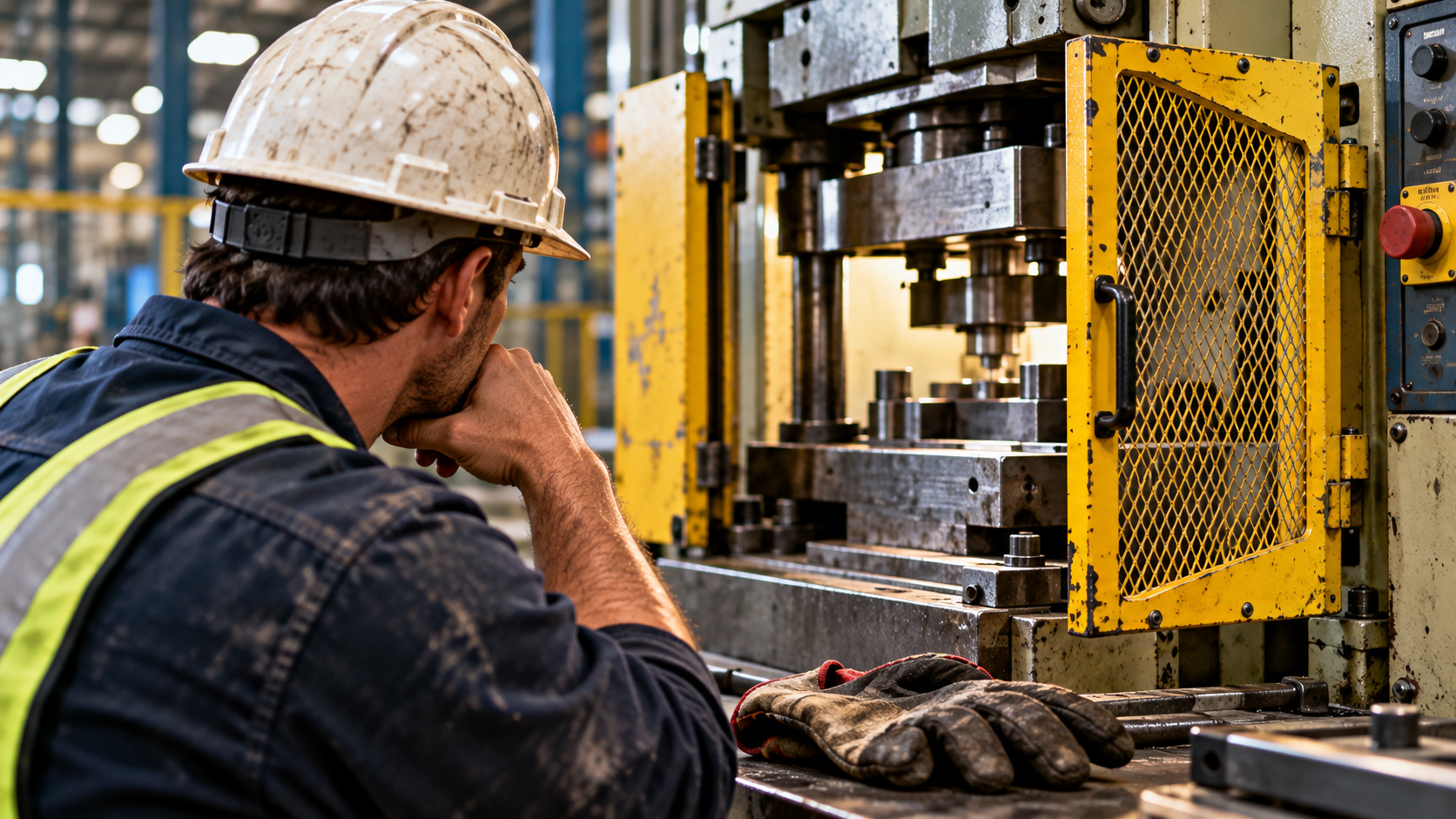
Consider an employee operating a hydraulic press at a manufacturing plant. The machine was originally equipped with two-hand safety controls designed to prevent the operator’s hands from being near the press when it activates. However, a supervisor has bypassed those controls so the machine can operate using a foot pedal, allowing employees to work faster. If an employee’s hand is crushed while operating the modified machine, the employee may have a claim beyond ordinary workers’ compensation benefits.
Alabama law specifically addresses this type of dangerous conduct.
Under Ala. Code § 25-5-11(c)(2), an injured employee may bring a personal injury claim against their employer or a fellow employee, including a supervisor, who willfully and intentionally removes a safety guard or safety device provided by the machine’s manufacturer, with knowledge that injury or death would likely or probably result. The removal must increase the danger of using the machine, and the statute provides exceptions for certain repairs and modifications.
Importantly, Alabama courts have recognized that a safety device does not necessarily have to be physically removed from the machine for this law to apply.
In Harris v. Gill, 585 So. 2d 831, 835–39 (Ala. 1991), an employee suffered severe injuries while operating a hydraulic press. The machine’s original two-hand safety controls had been bypassed, allowing the press to operate through a foot pedal. Although the safety controls remained physically attached to the machine, they no longer performed their intended protective function. The Alabama Supreme Court held that bypassing the safety controls could constitute their removal under § 25-5-11(c)(2).
The Court reached a similar conclusion in Bailey v. Hogg, 547 So. 2d 498, 499–500 (Ala. 1989), recognizing that the willful and intentional failure to install an available manufacturer-provided safety guard could be treated as its removal. In Moore v. Reeves, 589 So. 2d 173, 177–79 (Ala. 1991), the Court also recognized that a failure to maintain or repair a manufacturer-provided safety device could, under the circumstances, fall within the statutory exception.
These decisions are particularly important in manufacturing facilities, where machinery may be modified over time to increase production, accommodate different materials, or simplify operation. A safety switch may be bypassed, a protective guard may be left off after maintenance, or equipment may continue operating despite a known problem with a safety mechanism.
However, not every machine accident or workplace safety violation creates a separate personal injury claim. Alabama law imposes specific requirements, and an injured worker must establish more than the fact that a machine was dangerous or that an accident could have been prevented. The evidence must support the particular statutory elements, including the required knowledge, increased danger, and causal connection between the removal of the safety device and the injury.
That is why investigating a serious machinery accident promptly is so important. The machine may be repaired, modified, or returned to service before anyone documents its condition. Photographs, manufacturer specifications, maintenance records, prior safety complaints, and testimony from employees familiar with the equipment may help establish whether a protective device was deliberately removed or disabled.
For an injured manufacturing worker, the distinction can be significant. Workers’ compensation generally provides medical and disability benefits without requiring proof that the employer was negligent. But when an injury involves the intentional removal of a manufacturer-provided safety device, Alabama law may also permit a separate personal injury claim against the party legally responsible for that conduct.
Can I Have Both a Workers’ Compensation Claim and a Person Injury Claim?
Yes, in appropriate circumstances.
Under Ala. Code § 25-5-11(a), an injured employee may pursue a claim against a legally responsible third party while also receiving workers’ compensation benefits; however, workers’ compensation reimbursement and credit rules may affect the proceeds of a third-party recovery.
The claims must be coordinated carefully.
An ordinary negligence lawsuit against the employer is generally barred by workers’ compensation exclusivity when the Act applies. A separate third-party claim requires an independently viable legal basis.
What Should I Do Immediately After a Manufacturing Accident?
First, obtain necessary medical care.
Report the injury to your employer as promptly as possible and follow the applicable reporting procedures.
Alabama’s workers’ compensation notice statute, Ala. Code § 25-5-78, generally requires written notice within five days, subject to statutory exceptions, and imposes a ninety-day outer limit for accident notice. An employer’s actual knowledge may also be legally significant.
Do not assume that mentioning pain to a coworker is always enough.
Make sure the employer knows what happened, when it happened, and that you were injured.
Recommended Reading: Can I Sue My Employer Outside of Alabama’s Workers Compensation Laws?
My Boss Says I Waited Too Long to Report My Injury” — What Does ‘Notice’ Really Mean?
Also preserve information about the accident when you can safely and lawfully do so. This may include photographs, names of witnesses, incident reports, equipment identification, and the names of contractors or outside companies involved.
For injuries that developed gradually, keep a detailed description of the repetitive tasks you performed and when symptoms began.
Do not remove confidential company records or interfere with an accident investigation. An attorney can help seek preservation of relevant evidence through appropriate channels.
What If the Insurance Company Denies My Claim?
Manufacturing workers may encounter several kinds of disputes. The insurance company may contend that the injury was caused by a preexisting condition, occurred outside work, or did not result from the reported accident.
Recommended reading: Did My Work Accident Cause a New Injury, an Aggravation or Exacerbation of an earlier injury or Just a Recurrence? Understanding Preexisting Conditions in Alabama Workers Compensation Cases
For repetitive-motion injuries, the insurer may challenge the relationship between the job duties and the medical diagnosis.
Other disputes may concern authorized medical treatment, permanent restrictions, impairment ratings, or the employee’s ability to return to work, but you have to remember-a denial is not necessarily the final word.
Medical evidence, employment records, and testimony about actual job duties can be important in determining whether benefits are owed.
Can I Apply for Social Security Disability After a Manufacturing Injury?
Yes, if your medical conditions and work limitations satisfy Social Security’s federal disability requirements.
An employee who cannot return to manufacturing work may qualify for Social Security Disability Insurance (SSDI), depending on work history, medical evidence, duration of disability, and the ability to perform other work, but being unable to return to a physically demanding manufacturing position does not automatically qualify someone for SSDI.
Our article “Can I Get Social Security Disability After a Serious Car Wreck?” explains the federal disability standard. Those rules apply to qualifying disabilities regardless of whether the injury occurred in a car wreck, manufacturing plant, or another setting.
Workers’ compensation payments can also affect SSDI benefits under federal offset rules, so the interaction should be considered when evaluating a settlement.
Recommended reading: I Was Seriously Hurt at Work and Can’t Work, Can I Receive Workers’ Compensation and Social Security Disability Benefits?
Manufacturing Injuries Can Have Lasting Consequences
A manufacturing employee may spend decades developing skills that are valuable in a particular plant or industry.
A serious injury can suddenly make those skills difficult or impossible to use.
Alabama workers’ compensation may provide medical and disability benefits. A defective product or qualifying third-party conduct may create additional legal rights. And permanent work limitations may raise questions about Social Security Disability.
The appropriate approach depends on how the injury occurred, what medical restrictions remain, and which legal claims are supported by the evidence.
Talk With Powell & Denny About an Alabama Manufacturing Injury
If you were seriously injured in an Alabama manufacturing plant, you may have questions about medical treatment, workers’ compensation benefits, returning to work, or whether another company bears responsibility for the accident.
At Powell & Denny, P.C., we represent injured Alabama workers in workers’ compensation, personal-injury, and Social Security Disability matters. We understand how a serious workplace injury can threaten both your health and your ability to support your family, so if you have suffered serious injuries and you are worried about being able to return to work, don’t hesitate to contact and speak with one of the experienced attorneys at Powell and Denny today for a free consultation. Appointments are available in person, or virtually via Zoom if more convenient. Powell and Denny would appreciate the opportunity to help. And remember, there is no fee unless you win.
Powell & Denny: We Work When You Can’t.
We Wrote the Book
My Alabama Disability Claim by William Powell & Gregory Denny Click Here to Get Your Free Copy


-
 5.0/5.0
A++++++ got results and staff is friendly
-
5.0/5.0
A++++++ got results and staff is friendly
-
5.0/5.0
Persevering for 2-3 years to get my disability. Thank You.
-
5.0/5.0
Persevering for 2-3 years to get my disability. Thank You.
-
 5.0/5.0
William Powell is an excellent attorney and a leader in our local bar.
