
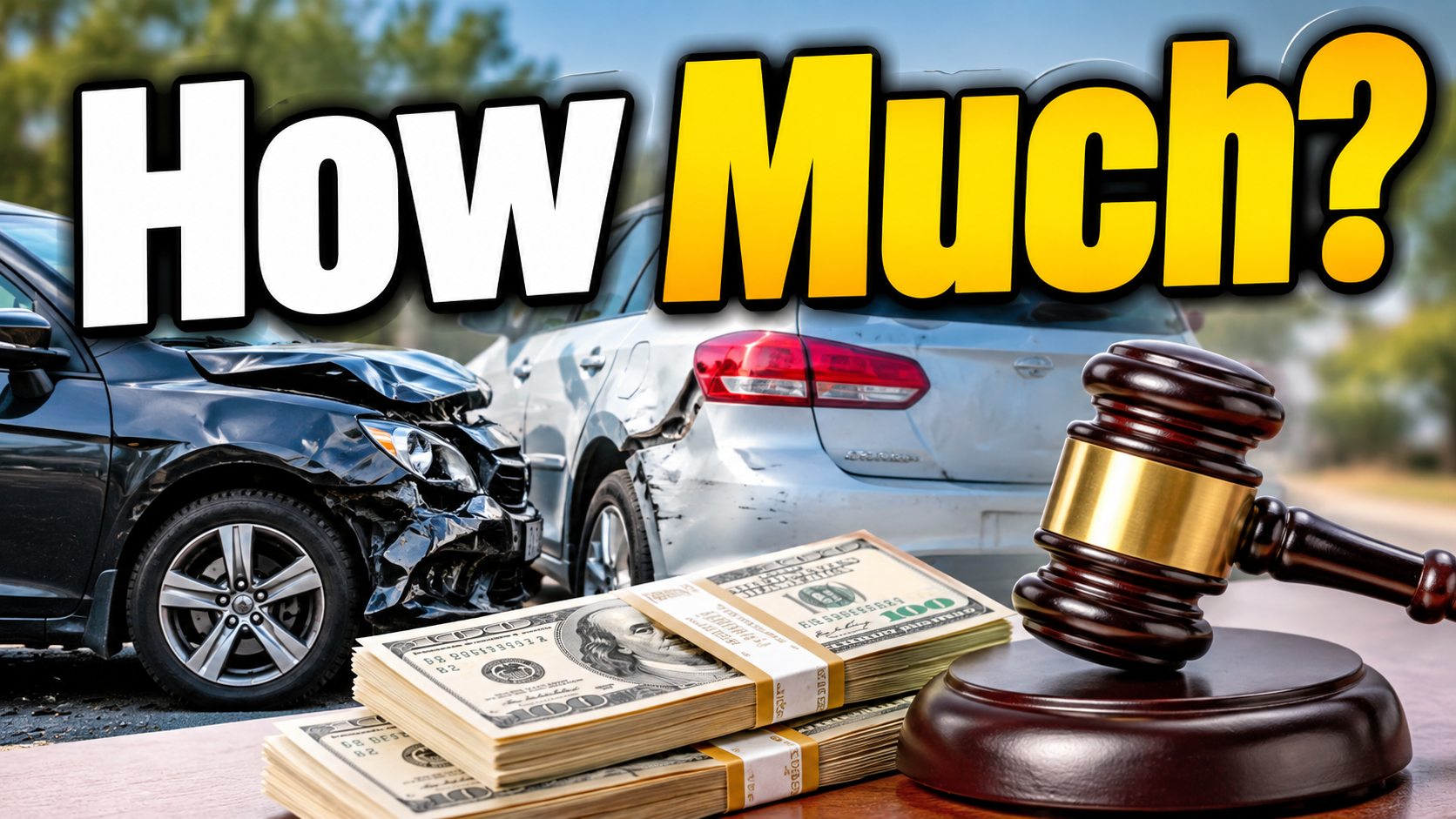
How Much Is My Alabama Car Wreck Case Worth?
After a serious car wreck, one of the first questions an injured person understandably asks is: How much is my case worth?
There is no Alabama statute, insurance formula, or settlement calculator that can answer that question simply by entering the amount of your medical bills. Two people can be involved in similar wrecks and have very different claims. One may recover fully after several weeks of treatment. The other may require surgery, develop permanent restrictions, lose the ability to perform a physically demanding job, and experience pain for years.
Even two people with similar injuries may have very different cases if liability, insurance coverage, medical causation, or the available evidence differs.
A useful way to think about the value of an Alabama car wreck claim is to ask four separate questions:
What damages did the wreck cause?
What can we prove?
Can we establish the other driver’s legal responsibility?
What insurance or other assets are actually available to pay the claim?
The answer to all four can affect what a case is ultimately worth.
Is There a Formula for Determining What an Alabama Car Wreck Case Is Worth?
No.
You may see websites claiming that a personal injury case is worth two or three times the medical expenses. You may also find online “settlement calculators” that ask for medical bills, lost wages, and a few other numbers before producing an estimated settlement.
That is not how Alabama law determines damages.
Medical expenses can be an important part of a personal injury claim, but they are only one part. Alabama recognizes damages that may include reasonable and necessary medical expenses, lost earnings, impairment of earning capacity, physical pain and suffering, mental anguish, permanent injury, disability, and other losses established by the evidence.
Some of those damages can be calculated fairly precisely. If you missed four weeks of work and earned $1,000 per week, the starting point for calculating your past lost earnings may be relatively straightforward.
There is no comparable mathematical formula for determining what six months of significant back pain is worth—or what it means to a 40-year-old construction worker to live permanently with physical restrictions.
The Alabama Supreme Court has specifically recognized that there is no fixed monetary standard for physical pain and mental anguish. That is why a medical-bill multiplier cannot reliably determine the value of a claim.
What Are Compensatory Damages?
Most of what people mean when they ask what their car wreck case is “worth” involves compensatory damages.
Compensatory damages are intended to compensate an injured person for losses caused by another person’s wrongful conduct. Depending upon the evidence, those damages may include both economic damages and noneconomic damages.
Economic damages can include things such as medical expenses and lost income.
Noneconomic damages can include losses that cannot be reduced to an invoice or paycheck, such as physical pain, mental anguish, physical impairment, and the effect a permanent injury has on someone’s life.
A serious car wreck case should therefore be evaluated by looking at the entire effect of the injury, not merely the amount appearing at the bottom of the medical bills.
How Do My Injuries Affect the Value of My Case?
The nature and severity of the injuries are obviously important. A cervical strain that completely resolves after several weeks is different from a cervical disc injury requiring fusion surgery.
A fractured wrist that heals completely is different from one that leaves permanent loss of motion and prevents a mechanic from using tools. Relevant considerations can include:
- the diagnosis;
- objective medical findings;
- length and type of treatment;
- surgery or other invasive treatment;
- duration and severity of symptoms;
- permanent impairment;
- permanent physical restrictions;
- future medical treatment;
- scarring or disfigurement;
- effect on employment; and
- effect on ordinary activities and quality of life.
But the diagnosis alone does not determine case value.
The important question is often what the injury actually did to this particular person.
Do My Medical Bills Determine What My Case Is Worth?
No.
Alabama generally permits recovery of medical expenses that are reasonable and necessary and related to the injury caused by the defendant., but the amount billed is not synonymous with the value of the entire personal injury claim.
Consider two people who each incur $30,000 in medical expenses. One undergoes treatment and makes a complete recovery. The other continues to experience chronic pain, receives permanent restrictions, can no longer perform his previous job, and is expected to need future treatment.
Their medical bills might be identical-their damages are not.
Does Surgery Make a Car Wreck Case Worth More?
Surgery is certainly an important fact, but there is no Alabama rule assigning a particular dollar value to a surgery.
A surgery may provide evidence concerning the severity of the injury and the treatment required because of it. But the complete medical picture still matters.
What surgery was performed?
Why was it necessary?
Did the wreck cause the condition requiring surgery?
Was the surgery successful?
Does the person still have pain?
Are there permanent restrictions?
Will additional surgery or treatment be necessary?
Can the person return to work?
A surgery should therefore be evaluated as part of the injury’s overall effect rather than plugged into a predetermined settlement formula.
What About Future Medical Treatment?
Future medical consequences can substantially change the evaluation of a serious injury. If a physician believes an injured person will require future injections, surgery, medication, therapy, or other treatment because of the wreck, those future consequences should not simply be ignored because the expenses have not yet been incurred.
This is one reason settling a case too early can be dangerous.
A person who accepts a final settlement before the medical prognosis becomes reasonably clear may later discover that the injury is more serious—and more expensive—than originally believed.
Recommended Reading: The Insurance Company Offered Me a Settlement After My Car Wreck. Should I Take It?
How Do Lost Wages Affect the Value of My Case?
Past lost earnings are another potentially recoverable element of damages, but a serious injury can create a much larger economic issue: What if you can return to some work but can no longer earn what you could before the wreck?
Alabama law distinguishes lost earnings from impairment of earning capacity.
Lost earnings generally concern work time and income already lost.
Impairment of earning capacity concerns a reduction in the injured person’s ability to earn a living because of the injury. The Alabama Supreme Court has explained that there must be evidence from which the factfinder can reasonably connect the physical disability to a diminished ability to perform work.
That distinction can become extremely important.
Imagine a 35-year-old electrician who earns $70,000 per year and suffers a permanent back injury. He eventually returns to work, so his past lost wages may not be enormous, but suppose his doctors permanently restrict him from the lifting, climbing, bending, and physical activity required by his trade.
The more important economic question may be what that restriction does to his earning capacity over the remainder of his working life.
In an appropriate case, medical evidence, employment records, vocational evidence, and economic evidence may all become relevant to that question.
Does a Permanent Impairment Rating Determine What My Car Wreck Case Is Worth?
No.
A physician’s impairment rating can be useful evidence of permanent physical loss, but it is not a price tag.
A 10% impairment rating does not mean a car wreck case is worth 10% of some predetermined amount.
And two people with the same medical impairment can experience very different consequences. A permanent shoulder impairment may affect a sedentary accountant differently from a carpenter who spends the workday lifting material and working overhead.
The impairment rating is therefore evidence concerning the injury; the legal damages inquiry is broader: what effect has that injury had, and will it continue to have, on the person’s life and ability to function?
How Are Pain and Suffering Valued?
This is one of the most misunderstood parts of a personal injury claim. There is no Alabama schedule that says:
Broken leg = $50,000.
Back surgery = $100,000.
Six months of pain = three times the medical bills.
The Alabama Supreme Court has explained that the law has no fixed monetary standard for physical pain and mental anguish.
Instead, the evidence matters.
How severe was the pain?
How long did it last?
Is it continuing?
Does it interfere with sleep?
Can the person still exercise, hunt, fish, garden, play with children or grandchildren, maintain the home, or participate in other activities that were important before the wreck?
Has the injury changed how the person functions from day to day?
In Alabama Power Co. v. Henderson, for example, the Alabama Supreme Court recognized that personal-injury damages can involve much more than lost earnings. The Court discussed disability, loss of earning capacity, physical and mental suffering, physical impairment, and the different course an injured person’s future life may take.
That is a much better way to understand noneconomic damages than attempting to multiply medical bills by an arbitrary number.
What If I Had Back, Neck, or Knee Problems Before the Wreck?
A preexisting medical condition does not automatically eliminate a car wreck claim, but it can make causation one of the most important issues in the case.
The defendant is responsible for damages proximately caused by the defendant’s wrongful conduct. Alabama law recognizes that an injury can aggravate a preexisting condition, but the plaintiff still must establish the causal connection between the defendant’s conduct and the injury or aggravation for which damages are sought.
Suppose you had occasional lower-back pain before the wreck but were working full time without restrictions. After the collision, you develop substantially worse symptoms, require an MRI, undergo injections, and ultimately need surgery.
The insurance company may argue: “That was already there.”
Your claim may be: “The preexisting condition existed, but this wreck materially aggravated it and produced symptoms and limitations I did not have before.”
Medical records from before and after the collision can become particularly important in resolving that dispute.
We will address that issue in greater detail in a later article devoted specifically to preexisting conditions and Alabama car wreck claims.
Does a Gap in Medical Treatment Reduce the Value of My Case?
It can affect the evidence.
An insurance company may argue that a substantial unexplained gap in treatment indicates that the injury had resolved or that later symptoms came from something other than the wreck.
That does not mean every treatment gap destroys a claim. There may be legitimate explanations: difficulty obtaining an appointment, lack of insurance, inability to afford treatment, work obligations, temporary improvement, referral delays, or other circumstances.
But from an evidentiary standpoint, continuity of symptoms and treatment can matter when medical causation is disputed.
We will address treatment gaps separately later in this series because the issue deserves more than a paragraph.
What If I Did Not Go to the Emergency Room?
Not going to the emergency room does not automatically mean that you were not injured. Some injuries do not produce their full symptoms immediately. Some people reasonably believe they will improve without treatment.
But an insurer may nevertheless use delayed treatment as an argument against causation or severity.
The real issue is the evidence:
When did symptoms begin?
What symptoms occurred?
When was treatment first sought?
What did the initial medical records document?
What diagnosis was ultimately made?
What does the medical evidence say about causation?
Again, the absence of an ambulance ride or emergency-room visit is a fact to evaluate, not a mathematical deduction from case value.
Does Fault Affect What My Alabama Car Wreck Case Is Worth?
Enormously. A person can suffer catastrophic injuries and still have a difficult negligence case if liability cannot be established.
Alabama continues to apply contributory negligence to ordinary negligence claims. Contributory negligence can be a complete defense when the plaintiff’s own negligence proximately contributed to the injury.
That makes Alabama very different from comparative-fault states where damages may simply be reduced according to a percentage of fault.
Suppose an injured person has $200,000 in damages. If liability against the other driver is clear, that is one valuation situation.
If there is substantial evidence that the injured person ran a red light, changed lanes improperly, or otherwise contributed to causing the collision, the legal risk can be dramatically different.
This is why evaluating case value requires evaluating liability and damages together.
Recommended Reading: The Insurance Company Says the Car Wreck Was Partly My Fault. Can I Still Recover in Alabama?
Does Contributory Negligence Always End the Case?
No.
Among other things, contributory negligence is not a defense to wantonness. Alabama decisions distinguish negligence from wanton misconduct for this purpose; but that does not mean every bad driving decision is wanton.
In Ex parte Essary, the Alabama Supreme Court explained that wantonness involves conscious conduct undertaken with awareness that injury will likely or probably result. The Court rejected a wantonness claim based merely on the driver’s conduct in failing to completely stop and attempting to cross an intersection under the facts before it.
So, an attorney evaluating a car wreck should distinguish between evidence of negligence and evidence capable of supporting wantonness.
Can Punitive Damages Increase the Value of a Car Wreck Case?
Potentially—but punitive damages should not be treated as an automatic component of an automobile claim.
Most car wreck cases involve negligence and compensatory damages.
Where the evidence establishes the kind of wrongful conduct required by Alabama law, punitive damages may become an additional issue. Alabama Code § 6-11-20 generally requires clear and convincing evidence of conduct such as wantonness before punitive damages may be awarded. Alabama defines wantonness for this purpose as conduct carried on with reckless or conscious disregard for the rights or safety of others.
Alabama also has statutory limitations governing punitive-damage awards, including provisions specifically addressing actions involving physical injury, but the practical point is simpler:
Speeding, distraction, or another traffic violation does not automatically create punitive damages.
The particular facts and the defendant’s state of knowledge matter.
How Does the Available Insurance Affect What My Case Is Worth?
This is where we need to distinguish between the amount of damages a person has suffered and the amount that can actually be recovered.
They are not necessarily the same.
Suppose a person suffers catastrophic injuries producing $500,000 in legally provable damages.
The at-fault driver has Alabama’s minimum $25,000 bodily-injury liability coverage and no meaningful assets.
The injured person may have a claim worth far more than $25,000 as a measure of damages, while still facing a serious problem collecting anything beyond the available insurance.
Alabama’s minimum financial-responsibility limits remain $25,000 for bodily injury or death to one person, $50,000 for bodily injury or death to two or more people in one accident, and $25,000 for property damage.
That makes the insurance investigation extremely important in a serious-injury case.
What If My Damages Are Greater Than the Other Driver’s Insurance?
Then uninsured/underinsured motorist coverage may become critical.
Alabama Code § 32-7-23 generally requires automobile liability policies issued in Alabama to provide UM coverage unless the named insured rejects it. The statutory definition also encompasses an underinsured situation where the available liability insurance is less than the damages the injured person is legally entitled to recover.
Depending upon the policies and circumstances, additional UM/UIM coverage may substantially change the amount potentially recoverable.
That is why we should not evaluate a serious car wreck solely by asking: “What are the other driver’s policy limits?” We also ask: “What other insurance may apply?”
Recommended Reading: What Is Uninsured and Underinsured Motorist Coverage in Alabama?
Recommended Reading: What If the Driver Who Hit Me Doesn’t Have Enough Insurance to Pay My Damages?
Does Having $100,000 in Medical Bills Mean My Case Is Worth at Least $100,000?
Not necessarily.
That illustrates why damages and proof have to be separated. The medical treatment must be connected to the injuries caused by the wreck, and recoverable medical expenses generally must satisfy Alabama’s requirements concerning reasonableness and necessity.
Suppose someone has $100,000 in medical bills but:
the disputed surgery occurred two years after the wreck;
the person had substantial treatment for the same condition before the collision;
there was a long unexplained treatment gap;
another accident occurred in between;
or the medical evidence does not connect the surgery to the wreck.
The dollar amount on the bills does not resolve those causation problems.
Conversely, a person can suffer substantial damages without enormous medical bills—for example, where a permanent injury limits the ability to work or produces significant lasting impairment.
The amount of medical bills is evidence. It is not a verdict.
Does the Size of the Car Wreck Determine the Value of the Case?
Not by itself.
Photographs showing major vehicle damage can be powerful evidence about the collision, but vehicle damage and bodily injury are separate factual questions.
A badly damaged vehicle does not automatically prove a severe injury, and relatively modest visible vehicle damage does not establish that no injury occurred.
The medical evidence, mechanism of injury, symptoms, treatment, and other facts still matter.
The better question is not simply: “How bad does the car look?”
It is: “What does all of the evidence establish happened to the person inside it?”
Does the Insurance Company’s Settlement Offer Tell Me What My Case Is Worth?
No.
A settlement offer tells you what the insurance company is presently willing to pay to resolve the claim-that is not necessarily the same as the legal value of the damages.
The offer may reflect the insurer’s assessment of liability, causation, treatment, future damages, credibility, insurance limits, litigation risk, or other considerations. Sometimes an offer may be reasonable.
Sometimes it may substantially undervalue the claim.
That is why the question addressed in the previous article—whether to accept a particular settlement—is different from determining the underlying value of the case.
Why Does Evidence Affect Case Value?
Because damages that cannot be proved are difficult to recover.
A claim may involve substantial genuine losses, but those losses still need evidentiary support.
Depending upon the issue, useful evidence may include:
medical records;
diagnostic studies;
physician opinions;
medical bills;
employment and payroll records;
tax records;
photographs;
video;
witness testimony;
vehicle data;
accident reports;
vocational evidence;
economic evidence;
and testimony concerning how the injury changed the person’s daily life.
For serious injuries, evidence preservation can therefore directly affect the practical value of a claim.
A case is not valued solely by asking what happened. It is also valued by asking: What can we prove happened?
Why Can Two Lawyers Give Different Opinions About the Same Case?
Because case valuation is partly an assessment of uncertainty.
Some damages are relatively concrete. Others depend on disputed medical evidence, witness credibility, future prognosis, liability disputes, insurance questions, and ultimately how a jury may evaluate the evidence.
Reasonable lawyers can therefore disagree about settlement value without either having a secret formula the other lacks. An experienced attorney should be able to explain why particular facts increase or decrease the evaluation of a claim rather than simply announcing a number.
Can Anyone Tell Me Exactly What My Case Is Worth?
Usually not at the beginning. In fact, an early promise that a case is worth a specific amount should be viewed cautiously as the value may change as information develops.
An MRI may reveal an injury not visible on an X-ray.
Treatment may succeed—or fail.
A physician may impose permanent restrictions.
The injured person may discover that returning to the previous job is impossible.
Additional insurance may be identified.
Evidence concerning the collision may strengthen or weaken the liability case.
That is why responsible case valuation is usually a process, not a number generated during the first telephone call.
What Factors Usually Matter Most in a Serious Alabama Car Wreck Case?
Rather than looking for a multiplier, I would focus on the interaction of several questions:
Liability: Can we prove that another person or entity legally caused the wreck?
Contributory negligence: Is there evidence that could bar recovery on the negligence claim?
Medical causation: Can we establish that the wreck caused or aggravated the injuries for which compensation is sought?
Severity and permanency: Did the injury resolve, or will it produce lasting consequences?
Future medical care: Is additional treatment reasonably expected?
Economic loss: What wages have been lost, and has earning capacity been permanently affected?
Human loss: What pain, mental anguish, disability, impairment, or disruption of life has the injury caused?
Evidence: How well can each of those losses be proved?
Insurance and collectability: What sources actually exist from which a recovery can be made?
Those factors interact.
A devastating injury with no provable liability may produce no recovery.
Clear liability with a minor temporary injury may produce a relatively modest claim.
A permanent disabling injury, clear liability, strong medical causation, good documentation, and adequate insurance presents a very different case.
At Powell & Denny, P.C., we evaluate Alabama car wreck cases by examining the entire effect of the injury rather than applying an arbitrary multiplier to the medical bills. If you have been seriously injured in an Alabama car wreck, we can review the collision, your medical treatment, the effect of the injury on your work and daily life, and the insurance coverage that may be available, so if you have been injured in a car wreck and have questions about your rights — don’t hesitate to contact and speak with one of the experienced Alabama Car Wreck attorneys at Powell and Denny today for a free consultation. Appointments are available in person, or virtually via Zoom if more convenient. Powell and Denny would appreciate the opportunity to help. And remember, there is no fee unless you win.
Powell & Denny: We Work When You Can’t.
This article provides general information about Alabama law and is not legal advice concerning any particular case.
We Wrote the Book
My Alabama Disability Claim by William Powell & Gregory Denny Click Here to Get Your Free Copy


-
 5.0/5.0
A++++++ got results and staff is friendly
-
5.0/5.0
A++++++ got results and staff is friendly
-
5.0/5.0
Persevering for 2-3 years to get my disability. Thank You.
-
5.0/5.0
Persevering for 2-3 years to get my disability. Thank You.
-
 5.0/5.0
William Powell is an excellent attorney and a leader in our local bar.
