By William Powell of Powell & Denny | Published December 6, 2025 | Posted in Social Security Disability, Uncategorized | Tagged Tags: Residual Functional Capacity (RFC): Where Many Social Security Disability Claims Are Won or Lost, The Sequential Process |

Residual Functional Capacity (RFC): Where Many Social Security Disability Claims Are Won or Lost The Sequential Process
Residual Functional Capacity (RFC): Where Many Social Security Disability Claims Are Won or Lost Understanding Step Four of Social Security’s Five-Step Sequential Evaluation Process Part Five of Powell & Denny’s Guide to Social Security Disability Benefits “My doctor agrees I can’t do my old job anymore. Doesn’t that mean I should receive disability benefits?” Not Read More
Read MoreDo You Have to Meet a Listing to Win Your Disability Claim? The Sequential Process
Do You Have to Meet a Listing to Win Your Disability Claim? Understanding Step Three of Social Security’s Five-Step Sequential Evaluation Process “My doctor told me I don’t meet one of Social Security’s Listings. Does that mean I can’t receive disability benefits?” We hear some version of that question all the time. Unfortunately, many doctor’s Read More
Read MoreWhat Does Social Security Mean by a “Severe” Impairment? The Sequential Process
What Does Social Security Mean by a “Severe” Impairment? Understanding Step Two of Social Security’s Five-Step Sequential Evaluation Process Part Three of Powell & Denny’s Guide to Social Security Disability Benefits At Step Two of the Five Point Sequential Evaluation Process, Social Security asks Do you have one or more medically determinable impairments that significantly Read More
Read MoreCan You Work and Still Receive Social Security Disability Benefits? The Sequential Process
Can You Work and Still Receive Social Security Disability Benefits? Understanding Step One of Social Security’s Five-Step Sequential Evaluation Process Part Two of Powell & Denny’s Guide to Social Security Disability Benefits Some people believe they must quit working before they can even apply for Social Security Disability benefits. Others believe that working even a Read More
Read MoreHow Social Security Decides Disability: The Five Questions That Determine Every Social Security Disability Claim The Sequential Process
How Social Security Decides Disability: The Five Questions That Determine Every Social Security Disability Claim Part One of Powell & Denny’s Guide to Social Security Disability Benefits “I have serious medical problems. My doctor says I can’t work anymore. Why did Social Security deny my disability claim?” It is one of the most common questions Read More
Read MoreAnxiety Disorders and Social Security Disability Benefits
Anxiety Disorders and Social Security Disability Benefits Mental illness is often suffered in silence. For that reason, it can be especially meaningful when individuals—particularly those in the public eye—speak openly about their struggles. Their willingness to share reminds others that they are not alone, a message that can be profoundly important for people who feel Read More
Read MoreComplex Regional Pain Syndrome (CRPS) and Social Security Disability Benefits
Complex Regional Pain Syndrome (CRPS) and Social Security Disability Benefits Complex Regional Pain Syndrome (CRPS)—historically referred to as Reflex Sympathetic Dystrophy (RSD)—is a chronic neurological pain condition that can develop after trauma, surgery, or injury to a limb. Although the initial injury may appear minor, CRPS can progress into a severe, disabling disorder involving the Read More
Read MoreMultiple Sclerosis (MS) and Social Security Disability
Multiple Sclerosis (MS) and Social Security Disability Multiple Sclerosis (MS) is a chronic, immune-mediated disease that affects the central nervous system—the brain, spinal cord, and optic nerves. MS can cause inflammation and damage to myelin (the protective covering around nerves) and, over time, may lead to significant physical, visual, and cognitive limitations. The exact cause Read More
Read MoreSSDI vs. SSI: Am I Eligible for Disability Benefits?
SSDI vs. SSI: Am I Eligible for Disability Benefits? Many people who contact our office have the same basic question:q “Do I qualify for Social Security Disability benefits?” The answer depends on which program you are applying for. There are two main federal disability programs: Social Security Disability Insurance (SSDI) Supplemental Security Income (SSI) While Read More
Read MoreCan Dementia Qualify for Social Security Disability Benefits?
Can Dementia Qualify for Social Security Disability Benefits? “Dementia” is a general term describing declining memory, thinking ability, judgment, and daily functioning caused by disease or injury to the brain. While Alzheimer’s disease is the most widely known form, many other types of dementia can be just as disabling, including: Vascular dementia Lewy body dementia Read More
Read More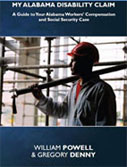
We Wrote the Book
My Alabama Disability Claim by William Powell & Gregory Denny Click Here to Get Your Free Copy


-
 5.0/5.0
A++++++ got results and staff is friendly
-
5.0/5.0
A++++++ got results and staff is friendly
-
5.0/5.0
Persevering for 2-3 years to get my disability. Thank You.
-
5.0/5.0
Persevering for 2-3 years to get my disability. Thank You.
-
 5.0/5.0
William Powell is an excellent attorney and a leader in our local bar.
