
Can You Really Perform Heavy Work? Understanding One of the Most Important Classifications in Workers’ Compensation and Disability Cases
For many injured workers, one sentence changes everything: “Your doctor has permanently restricted you from heavy work.”
Most people hear that and think: “Well, I can still work.”
Sometimes that’s true- Sometimes it isn’t.
Whether a person can perform heavy work is one of the most important vocational questions in both an Alabama workers’ compensation claim and a Social Security Disability claim. It often determines whether an injured worker can return to the career they have spent decades building—or whether they must begin over in an entirely different occupation.
Ironically, many workers who lose the ability to perform heavy work have never worked behind a desk. Their careers have involved construction, manufacturing, healthcare, trucking, maintenance, logging, mining, or warehouse work. When those jobs disappear because of permanent medical restrictions, the legal issues become much larger than a lifting restriction alone.
What Is Heavy Work?
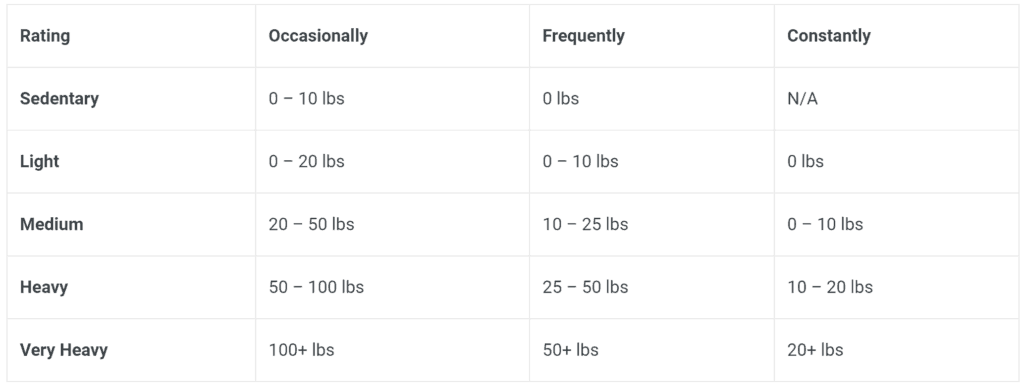
Social Security, the Dictionary of Occupational Titles (DOT), and vocational experts classify jobs according to their physical demands. Social Security defines heavy work through:
Heavy work generally means work that requires:
- lifting up to 100 pounds occasionally
- lifting or carrying up to 50 pounds frequently
- standing or walking for a significant portion of the workday
- frequent bending, stooping, crouching, climbing, carrying, pushing, and pulling
Unlike medium or light work, heavy jobs usually demand strength, endurance, balance, and the ability to repeatedly perform physically demanding tasks throughout an entire workday.
Examples include:
- construction laborers
- roofers
- iron workers
- heavy equipment mechanics
- many warehouse positions
- many manufacturing jobs
- oilfield workers
- many mining occupations
For these workers, the question is often not whether they can lift 100 pounds once; the question is whether they can safely perform these demanding activities day after day, eight hours a day, five days a week.
Heavy Work Requires Much More Than Heavy Lifting
One misconception we frequently encounter is that heavy work is determined only by how much weight a worker can lift.
It isn’t.
Many heavy occupations also require:
- climbing ladders
- frequent stooping
- crouching
- kneeling
- balancing
- carrying objects over uneven terrain
- overhead reaching
- pushing and pulling equipment
- repetitive gripping
A worker who develops permanent restrictions in only one of these areas may no longer be capable of performing the full range of heavy work, even if their lifting strength remains relatively good.
Recommended Reading: How Postural Restrictions Affect Alabama Workers’ Compensation and Social Security Disability Claims
One Restriction Can Drop You to Medium Work
This surprises many injured workers. Suppose a construction worker suffers a serious back injury. After surgery, the surgeon states:
- no lifting over 50 pounds
- occasional stooping only
- no ladder climbing
The worker may feel “pretty good,” but vocationally, those restrictions usually mean the worker no longer performs heavy work.
Instead, the worker may now be limited to medium work.
That distinction can permanently end careers involving:
- construction
- heavy manufacturing
- industrial maintenance
- heavy trucking
- mining
- logging
A single permanent restriction can remove dozens of occupations from consideration.
Recommended Reading: What Does “Medium Work” Really Mean? Understanding One of the Most Important Classifications in Workers’ Compensation and Disability Cases.
Workers’ Compensation Looks at Whether You Can Return to Your Job
Under Alabama Workers’ Compensation law, an inability to return to heavy work often has major vocational consequences.
If your injury is a body-as-a-whole (non-scheduled) injury, the court may consider:
- your age
- education
- work history
- transferable skills
- permanent restrictions
- ability to earn wages in the future
Someone who has spent thirty years performing heavy labor may have few transferable skills for sedentary office employment.
That does not automatically make the worker permanently and totally disabled, but tt does mean vocational evidence becomes extremely important.
Recommended Reading: What Happens If I Can’t Return to My Job After a Work Injury? Workers’ Compensation and Social Security Disability Explained.
Heavy Work Also Plays a Major Role in Social Security Disability Cases
Social Security asks two different questions. First:
Can you return to your past relevant work?
If the answer is no, Social Security asks: Can you perform any other work existing in significant numbers in the national economy?
Heavy work frequently becomes the dividing line.
Many workers over age fifty-five who have spent their entire careers performing heavy labor find themselves unable to adjust to other occupations after suffering permanent injuries.
Age, education, transferable skills, and the Medical-Vocational Guidelines (“Grid Rules”) may all become important. Under 20 C.F.R. Pt. 404, Subpt. P, App. 2, Table No. 3, Rule 203.01 states that a claimant is disabled if:
- RFC: Limited to medium work
- Age: 60–66 (closely approaching retirement age)
- Education: Limited or less
- Previous Work: Unskilled heavy or very heavy work
This rule recognizes that a worker with little education and a lifetime of heavy labor is not realistically able to transition to new medium‑level work at age 60+.
Recommended Reading: How Age Affects your claim
Recommended Reading: How Your Educational Level Affects you Claim
Recommended Reading: What is my RFC?
Recommended Reading: I Can’t Do My Old Job Anymore. Why Does Social Security Think I Can Do Another One? Transferability of Job Skills.
Sometimes the Problem Is Pain—Not Strength
Many workers remain physically strong after surgery, but their main problem is pain.
They may technically lift fifty pounds once, but they cannot repeatedly:
- bend
- twist
- climb
- crouch
- kneel
- crawl
throughout an entire workday.
Likewise, chronic pain medications may impair concentration, reaction time, or balance, making heavy work unsafe even when strength has largely returned.
Recommended Reading: Can Pain Alone Keep Me from Working? Understanding Pain in Alabama Workers’ Compensation and Social Security Disability Claims.
Also see: How Medication Side Effects Affect Alabama Workers’ Compensation and Social Security Disability Claims.
Functional Capacity Evaluations Frequently Address Heavy Work
After reaching Maximum Medical Improvement (MMI), many injured workers undergo a Functional Capacity Evaluation (FCE).
An FCE may evaluate:
- lifting
- carrying
- pushing
- pulling
- climbing
- crouching
- kneeling
- gripping
- endurance
- positional tolerances
The evaluator often assigns the worker to one of the recognized exertional levels:
- Sedentary
- Light
- Medium
- Heavy
- Very Heavy
These findings frequently influence:
- permanent restrictions
- return-to-work decisions
- vocational testimony
- settlement negotiations
Although an FCE is only one piece of evidence, it often becomes a significant part of both workers’ compensation and Social Security Disability claims.
Recommended Reading: What does Maximum Medical Improvement (MMI) Mean?
Recommended Reading: What Is a Functional Capacity Evaluation (FCE), and How Can It Affect My Workers’ Compensation Claim?
The Bottom Line
Heavy work involves far more than lifting heavy objects. It requires the ability to repeatedly perform physically demanding activities throughout an entire workday, including standing, walking, climbing, stooping, crouching, carrying, pushing, pulling, and maintaining balance.
When a workplace injury permanently prevents an employee from performing the full range of heavy work, the consequences can extend well beyond the inability to return to one job. In Alabama workers’ compensation cases, permanent restrictions may substantially reduce a worker’s earning capacity, particularly when the injury is treated as a body-as-a-whole injury. In Social Security Disability cases, those same restrictions may become critical when combined with a worker’s age, education, past relevant work, transferable skills, and the Medical-Vocational Guidelines.
At Powell & Denny, we have represented injured and disabled workers throughout Alabama for more than 30 years. We understand that serious claims are rarely decided by lifting restrictions alone. They are decided by how the injury affects the person’s ability to function, work, and earn a living.
If you have questions about an Alabama Workers’ Compensation claim, or a claim for Social Security Disability benefits, don’t hesitate to contact the experienced attorneys at Powell and Denny today a free consultation; remember. Virtual appointments are available through Zoom so you can meet with one of the attorneys of Powell and Denny from wherever you live, and remember-there is no fee unless you win.
Powell & Denny: We Work When You Can’t.
Offices in Birmingham, Alabama and Huntsville, AL
Next-and Last- in this Series: Why Work Classifications Matter: How Permanent Restrictions Can Change the Value of Your Workers’ Compensation Claim and Your Right to Social Security Disability Benefits
We Wrote the Book
My Alabama Disability Claim by William Powell & Gregory Denny Click Here to Get Your Free Copy


-
 5.0/5.0
A++++++ got results and staff is friendly
-
5.0/5.0
A++++++ got results and staff is friendly
-
5.0/5.0
Persevering for 2-3 years to get my disability. Thank You.
-
5.0/5.0
Persevering for 2-3 years to get my disability. Thank You.
-
 5.0/5.0
William Powell is an excellent attorney and a leader in our local bar.
