

Can You Be Permanently and Totally Disabled and Still Win an Alabama Retaliatory Discharge Case?
At first glance, these two positions may seem contradictory: “I am permanently and totally disabled because of my job injury.” And “My employer wrongfully fired me because I pursued workers’ compensation benefits.”
An employer defending an Alabama retaliatory discharge claim may argue: If you say you are permanently and totally disabled and unable to return to your former employment, how can you also claim damages because you were fired?
Alabama law recognizes that the answer is more complicated than it might appear.
Permanent Total Disability Does Not Necessarily Mean You Can Never Work Again
Under Alabama workers’ compensation law, permanent total disability does not necessarily mean that an injured worker is completely helpless or physically incapable of performing any type of work. The inquiry is broader.
In determining permanent total disability, courts can consider not only the worker’s physical limitations but also factors such as age, education, training, work history and the ability to obtain reasonably gainful employment. That distinction can be extremely important.
An injured worker might physically be capable of performing a low-paying or very limited job while nevertheless being permanently and totally disabled for purposes of Alabama workers’ compensation law.
For example, a worker who spent decades earning a good living performing heavy skilled labor may suffer an injury that leaves him capable of performing only limited, low-paying work. The fact that he might theoretically be capable of earning some money does not necessarily answer whether he is permanently and totally disabled under Alabama law.
Recommended Reading: [Do I Have to Be Able to Return to Work to Bring an Alabama Retaliatory Discharge Claim?] explains the Alabama Supreme Court’s decision in Bleier v. Wellington Sears Co., 757 So. 2d 1163 (Ala. 2000), and why being “willing and able” to return to work is not part of an employee’s prima facie retaliatory discharge case.
What Does Permanent Total Disability Have to Do With Retaliatory Discharge?
A retaliatory discharge case asks a different question. Under Ala. Code § 25-5-11.1, an employer cannot terminate an employee solely because the employee pursued workers’ compensation benefits.
The central issue is therefore why the employer terminated the employee.
Was there a legitimate reason unrelated to the workers’ compensation claim?
Or was the reason given by the employer a pretext for retaliation?
The Alabama Supreme Court’s decision in Bleier is particularly important here. The Court held that an employee’s willingness and ability to return to work is not an element of the employee’s prima facie retaliatory discharge case. The employee’s ability to work can, however, remain relevant to the employer’s defense and to the amount of lost wages the employee can recover.
In other words: An employee’s disability does not give an employer permission to retaliate against the employee for pursuing workers’ compensation benefits.
Recommended Reading: What Is Pretext in an Alabama Retaliatory Discharge Case? discusses how Alabama courts determine whether the reason given for firing an injured employee was the real reason for the termination.
We Have Actually Litigated This Issue
This is not merely a hypothetical issue for our firm. Powell & Denny represented an injured Alabama worker who was found permanently and totally disabled in his workers’ compensation case. The court considered his physical restrictions together with his age, education, training, work history and ability to obtain reasonably gainful employment. The court also considered evidence that jobs he might physically be capable of performing would pay substantially less than his pre-injury employment.
That same injured worker also pursued a retaliatory discharge claim against his former employer and ultimately received a $750,000 retaliatory discharge verdict in his favor.
The results were not inconsistent. The workers’ compensation case addressed the extent of the worker’s disability and loss of earning capacity. The retaliatory discharge case addressed why his employer fired him.
Recommended Reading: $750,000 Wrongful Termination Verdict in Bessemer, Alabama and What Does “Reasonably Gainful Employment” Mean in an Alabama Workers’ Compensation Claim?
What About Damages?
There is an important limitation. A permanently and totally disabled employee cannot necessarily claim that every dollar of wages lost after termination was caused by the retaliatory discharge.
Under Bleier, an employee’s inability to work can eliminate or reduce a claim for lost wages during a period when the employee could not have worked anyway. But that does not necessarily eliminate the retaliatory discharge claim itself. Depending upon the evidence, other compensatory damages—and potentially punitive damages—may still be available. Bleier v. Wellington Sears Co., 757 So. 2d 1163 (Ala. 2000).
That distinction between liability and damages is critical.
The Bottom Line
Yes. An Alabama worker can potentially be permanently and totally disabled under the Workers’ Compensation Act and still prevail on a retaliatory discharge claim.
The two claims answer different questions:
Workers’ compensation: What effect has the injury had upon the employee’s ability to work and earn a living?
Retaliatory discharge: Why did the employer fire the employee?
One does not necessarily answer the other.
If you suffered an Alabama job injury and were subsequently fired, don’t assume that serious permanent restrictions—or even a finding of permanent total disability—automatically prevents you from pursuing a retaliatory discharge claim.
If you have questions about whether your termination was related to your workers’ compensation claim, don’t hesitate to contact and speak with one of the experienced Alabama Workers Compensation and Social Security Disability attorneys at Powell and Denny today for a free consultation. Appointments are available in person, or virtually via Zoom if more convenient. Powell and Denny would appreciate the opportunity to help. And remember, there is no fee unless you win.
Powell and Denny: We Work When You Can’t.
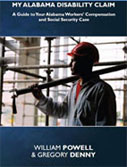
We Wrote the Book
My Alabama Disability Claim by William Powell & Gregory Denny Click Here to Get Your Free Copy


-
 5.0/5.0
A++++++ got results and staff is friendly
-
5.0/5.0
A++++++ got results and staff is friendly
-
5.0/5.0
Persevering for 2-3 years to get my disability. Thank You.
-
5.0/5.0
Persevering for 2-3 years to get my disability. Thank You.
-
 5.0/5.0
William Powell is an excellent attorney and a leader in our local bar.
