

Can I Get Social Security Disability After a Serious Car Wreck?
You were seriously injured in a car wreck. You have undergone surgery, attended physical therapy, and followed your doctor’s treatment recommendations. Months later, you still cannot return to work.
Perhaps your back injury prevents you from lifting heavy objects. Maybe you suffered a traumatic brain injury that affects your memory and concentration. Or chronic pain makes it difficult to sit, stand, or walk for an entire workday.
You may be wondering whether Social Security Disability can help support your family while you are unable to work.
Yes. A person who becomes disabled after a serious automobile accident may qualify for Social Security Disability benefits. But being injured in a car wreck does not automatically establish disability under federal law.
The Social Security Administration evaluates how your medical conditions affect your ability to perform work, not simply how the injuries occurred.
What Does Social Security Consider a Disability?
Social Security Disability Insurance (SSDI) is a federal program that provides monthly benefits to qualifying workers who can no longer engage in substantial gainful activity because of a disabling medical condition. Generally, the condition must have lasted, or be expected to last, at least 12 continuous months or result in death.
This is an important distinction for people injured in automobile accidents.
Someone who suffers a fractured leg and misses four months of work may have a substantial personal-injury claim against the negligent driver, but if that person recovers sufficiently to return to substantial work within twelve months, the injury ordinarily will not satisfy Social Security’s duration requirement.
By contrast, a person with permanent spinal injuries, significant neurological problems, or other long-term limitations may qualify if the remaining requirements are met.
You do not have to wait until you have been out of work for twelve months to apply. If the medical evidence supports an expectation that your disabling limitations will continue for the required period, you can apply earlier.
Does It Matter Whether Someone Else Caused the Car Wreck?
Not for determining whether you are medically disabled under Social Security’s rules.
Social Security does not require you to prove that another driver was negligent.
It generally does not matter whether you were injured by a distracted motorist, lost control of your own vehicle, or suffered injuries in an accident for which no one was legally responsible. The central question is whether your medically established conditions prevent substantial gainful work for the required duration.
That is very different from an Alabama personal-injury lawsuit. In a car wreck case, you generally must establish that another party’s legally actionable conduct caused your injuries and damages.
We explain the broader consequences of permanent work restrictions in our related article, “What If My Injuries Permanently Prevent Me From Working After an Alabama Car Wreck?”
What Injuries From a Car Wreck May Qualify for SSDI?
Many different injuries can potentially support a disability claim. Examples include serious spinal injuries, traumatic brain injuries, nerve damage, severe orthopedic injuries, and chronic pain associated with medically established conditions. Some people develop significant psychological conditions following a serious collision, including post-traumatic stress disorder, depression, or anxiety.
The diagnosis alone does not establish eligibility.
Social Security considers how the condition affects the person’s ability to function in a work setting. For example, a person with a lumbar injury may be unable to sit for prolonged periods, stand throughout a workday, or lift objects required by the former job.
Someone with a traumatic brain injury may have difficulty remembering instructions, concentrating, maintaining an appropriate work pace, or interacting with others.
The important evidence explains what you can and cannot do because of your medical conditions.
What If I Can No Longer Do My Old Job?
This is often the most important question for injured workers.
Suppose you have spent twenty-five years working in construction. Following a serious car wreck, your physician permanently restricts you from lifting more than ten pounds. You may clearly be unable to return to construction work.
But Social Security must also consider whether you can perform other work under its rules.
The agency uses a five-step evaluation process that examines current work activity, the severity of the medical conditions, whether those conditions meet or equal certain listed impairments, the ability to perform past relevant work, and the ability to adjust to other work.
At the final stage, factors such as age, education, work experience, and remaining functional capacity can become important.
A 58-year-old construction worker with limited transferable skills may be evaluated differently from a 28-year-old worker with substantial computer experience.
That does not mean older applicants automatically qualify or younger applicants cannot qualify. It means Social Security applies vocational rules that account for individual circumstances.
Recommended reading: How Can I Be Disabled Under Workers Compensation But Denied Social Security Disability?
Can I Qualify for SSDI If I Can Still Perform Some Activities?
Yes, potentially. An injured person does not have to be bedridden or completely helpless to qualify.
Someone may be able to drive short distances, prepare simple meals, shop for groceries, or perform limited household chores but still be unable to sustain competitive employment. For example, a person with a serious back injury may be able to sit for thirty minutes before needing to change positions or lie down.
The person might perform occasional tasks at home but be unable to maintain the attendance, productivity, and physical demands of a regular work schedule.
Social Security evaluates these limitations through a concept called residual functional capacity, or RFC. RFC describes what a person can still do despite medically established impairments (see What Is “Residual Functional Capacity” (RFC) in a Social Security Disability Case?)
The agency considers limitations involving sitting, standing, walking, lifting, concentration, and other work-related activities. The issue is not simply whether you can perform an activity once. It is whether your remaining abilities permit substantial work under the applicable rules.
What Medical Evidence Do I Need?
Medical evidence is essential to an SSDI claim. Social Security requires objective medical evidence from an acceptable medical source to establish a medically determinable impairment. Once the impairment is established, the agency considers other medical and nonmedical evidence when evaluating its severity and functional effects.
Useful evidence may include:
- Hospital and emergency-room records documenting the original injuries.
- MRI, CT, X-ray, and other diagnostic findings.
- Surgical reports and specialist evaluations.
- Physical therapy and rehabilitation records.
- Medical opinions explaining work-related restrictions.
- Neuropsychological testing or mental-health treatment records when relevant.
The most useful medical evidence connects the diagnosis to actual limitations. For example, a record stating that a patient has degenerative disc disease may establish a diagnosis.
But documentation explaining that the patient cannot lift more than ten pounds, must alternate between sitting and standing, or experiences significant neurological symptoms may provide a clearer picture of the person’s ability to work.
For individuals with continuing pain after a collision, our article “Can I Recover Compensation for Chronic Pain After an Alabama Car Wreck?” discusses why persistent symptoms and their functional consequences deserve careful documentation.
Recommended reading: Why Functional Limitations Matter More Than Medical Diagnoses in Social Security Disability and Alabama Workers’ Compensation Cases
Do I Have to Be Completely Unable to Work?
No. But the amount and nature of your work activity matter.
Social Security uses the term substantial gainful activity, commonly called SGA. For 2026, the monthly SGA earnings guideline for a nonblind individual is $1,690. A different amount applies to individuals who meet Social Security’s statutory blindness rules.
These amounts change periodically, and special rules apply in certain circumstances, including self-employment and unsuccessful work attempts.
Earning below the SGA guideline does not automatically establish disability as the applicant must still satisfy the medical and vocational requirements.
Likewise, someone who attempts to return to work but cannot continue because of the disabling condition should make sure that work history is accurately reported and evaluated.
Recommended reading: What Does “Substantial Gainful Activity” Mean in a Social Security Disability Claim?”
What If I Am Receiving Workers’ Compensation?
A person injured in a car wreck while performing covered employment may qualify for Alabama workers’ compensation and SSDI. For example, a delivery driver struck by a negligent motorist may have a workers’ compensation claim, a separate personal-injury claim against the motorist, and a potential SSDI claim; however, workers’ compensation benefits can reduce Social Security Disability benefits under federal offset rules.
The amount of the reduction depends on the circumstances, including the benefits received and the worker’s prior earnings.
A workers’ compensation settlement can also affect the calculation.
Because these claims may overlap, the potential Social Security consequences should be considered before settling a workers’ compensation case.
Recommended reading: Can I receive both Social Security Disability and Workers Comp?
Will a Car Wreck Settlement Affect My SSDI Benefits?
Generally, an ordinary personal-injury settlement is not treated as wages or workers’ compensation merely because the injured person receives money from the negligent driver’s insurer.
Consequently, a typical third-party car wreck settlement does not automatically reduce SSDI benefits; however, the nature of the payment matters. Workers’ compensation proceeds and certain other disability payments are governed by different rules.
There is also an important distinction between SSDI and Supplemental Security Income (SSI).
SSDI is primarily based on insured work history and disability. SSI is a needs-based program with income and resource limitations.
A personal-injury settlement may affect SSI eligibility even when it does not affect SSDI.
Someone receiving both programs should be especially careful before resolving a substantial personal-injury claim.
Recommended reading: SSDI vs. SSI: Am I Eligible for Disability Benefits?
How Long Does It Take to Receive SSDI Benefits?
There is no guaranteed approval timeline.
The process may involve an initial application, requests for medical records, additional examinations, and, if necessary, appeals. SSDI also generally has a five-full-calendar-month waiting period measured from the established disability onset date, subject to applicable exceptions.
That waiting period is different from the twelve-month disability-duration requirement.
Applicants should not assume they must wait twelve months before filing. Delaying an application can also create problems involving insured status and potential past-due benefits.
A person who is unable to work because of a serious accident should evaluate SSDI eligibility promptly rather than waiting until every other insurance claim is resolved.
What Should I Do If a Car Wreck Has Left Me Unable to Work?
If your injuries prevent you from returning to employment, obtain appropriate medical care and make sure your providers understand the actual physical and mental demands of your work.
Keep records of your treatment, work restrictions, unsuccessful attempts to return to work, and changes in daily functioning. Also preserve your employment history and earnings information.
If you have an ongoing personal-injury or workers’ compensation claim, consider how those matters may interact with a potential SSDI application. The same injury may be relevant to all three claims, but each program applies different legal standards.
A Serious Car Wreck Can Lead to More Than One Type of Claim
A person injured in an automobile accident may face years of medical treatment, permanent restrictions, and uncertainty about returning to work. An Alabama personal-injury lawsuit may provide compensation when another party is legally responsible for the injuries.
Workers’ compensation may provide benefits when the accident occurred during covered employment.
Social Security Disability may provide monthly income when the injured person meets the federal disability requirements.
You do not have to prove that another driver was at fault to qualify for SSDI. You must establish that your medical conditions and resulting limitations satisfy Social Security’s definition of disability.
Understanding these differences can help protect your financial future after a serious accident.
Talk With Powell & Denny About Social Security Disability After a Car Wreck
If an Alabama car wreck has left you unable to return to work, you may have questions about Social Security Disability, workers’ compensation, or a personal-injury claim.
At Powell & Denny, P.C., we represent injured Alabamians in all three areas. We understand how serious injuries can affect a person’s ability to work and how different benefit systems may interact, so if you have suffered serious injuries in an Alabama car wreck and you are worried about being able to return to work, don’t hesitate to contact and speak with one of the experienced Alabama Car Wreck attorneys at Powell and Denny today for a free consultation. Appointments are available in person, or virtually via Zoom if more convenient. Powell and Denny would appreciate the opportunity to help. And remember, there is no fee unless you win.
Powell & Denny: We Work When You Can’t.
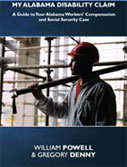
We Wrote the Book
My Alabama Disability Claim by William Powell & Gregory Denny Click Here to Get Your Free Copy


-
 5.0/5.0
A++++++ got results and staff is friendly
-
5.0/5.0
A++++++ got results and staff is friendly
-
5.0/5.0
Persevering for 2-3 years to get my disability. Thank You.
-
5.0/5.0
Persevering for 2-3 years to get my disability. Thank You.
-
 5.0/5.0
William Powell is an excellent attorney and a leader in our local bar.
