
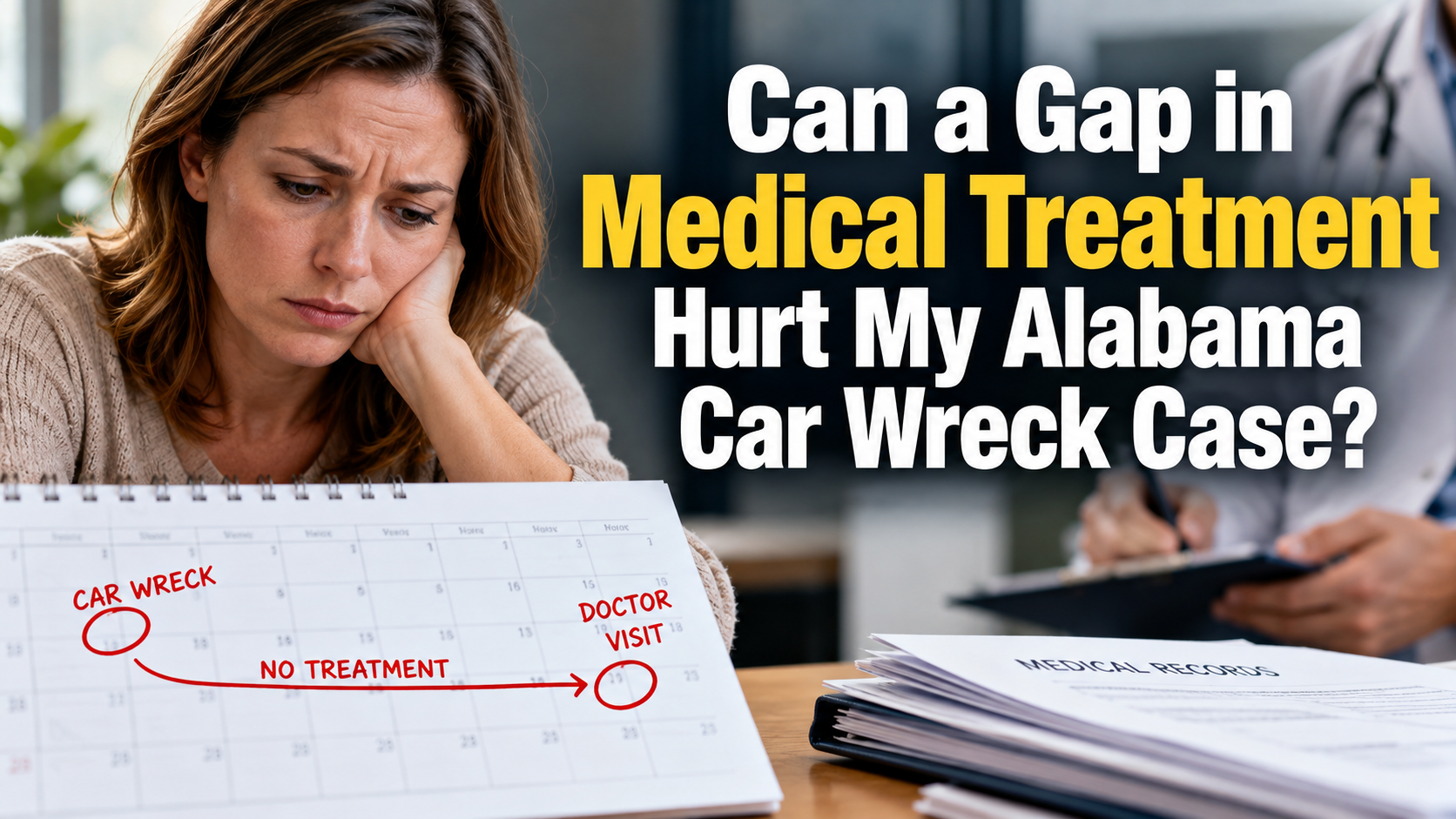
Can a Gap in Medical Treatment Hurt My Alabama Car Wreck Case?
A car wreck happens on Monday. You are sore that evening, but you think the pain will go away. You take over-the-counter medication and try to continue working. By Friday, your neck and back hurt worse. You finally go to an urgent-care clinic.
Or perhaps you receive treatment immediately after the wreck, attend physical therapy for several weeks, and then stop going. Three months later, the pain has not gone away, so you return to a doctor.
When you make an insurance claim, the adjuster points to the delay or gap in treatment:
“If you were really hurt in the wreck, why didn’t you go to the doctor sooner?”
Or:
“If you were still injured, why did you stop receiving treatment for three months?”
A gap in medical treatment can create a significant evidentiary problem in an Alabama car-wreck case. But a gap does not automatically mean that the wreck did not cause the injury or that the injured person cannot recover damages.
The important questions are why the gap occurred, what happened medically before and after it, and whether the evidence still establishes that the collision probably caused the condition for which damages are being claimed.
What Is a “Gap in Treatment”?
There is no particular number of days or weeks that automatically creates a legally disqualifying “gap in treatment.” The phrase generally describes a period during which an injured person either delays obtaining medical care or stops receiving care for a significant period.
There are really two different types of treatment gaps:
A delay between the car wreck and the first medical treatment.
For example, the collision occurs on June 1, but the injured person does not seek medical treatment until June 10. Or perhaps the injured person goes to the emergency room on the day of the wreck, follows up with a doctor and attends physical therapy, but then receives no treatment for several months before returning with similar complaints.
Those situations can present different evidentiary problems.
Why Does the Insurance Company Care About a Treatment Gap?
Because a personal-injury plaintiff must prove causation.
It is not enough to establish that another driver negligently caused a wreck and that the plaintiff later had a medical problem. The plaintiff must establish the necessary causal relationship between the defendant’s conduct and the injury for which damages are sought.
A significant period without medical treatment gives the insurance company an opportunity to challenge that connection. The insurer may argue:
The injury could not have been serious because the person did not seek immediate treatment.
The person must have recovered because treatment stopped.
The later symptoms were caused by something that happened after the wreck.
The later medical treatment involved a different condition.
The person’s current complaints are caused by a preexisting degenerative condition rather than the collision.
Those arguments do not become true merely because a treatment gap exists. But a gap can make the factual question of causation more difficult, that is why the medical history surrounding the gap matters.
I Didn’t Go to the Emergency Room. Does That Mean I Wasn’t Injured?
No.
There is no rule that an injured person must leave the accident scene in an ambulance or go immediately to an emergency room in order to have an Alabama personal-injury claim.
People respond differently after a collision.
Someone may initially believe the pain is ordinary soreness. Symptoms may become more noticeable after the person returns home. A person may try to work through the pain before realizing that the condition is not improving. So the legal issue is not simply: “Did you go to the emergency room?” It is: “Can the evidence establish that the condition for which you are seeking damages was probably caused or aggravated by the collision?”
That evidence can include medical records, diagnostic studies, physician testimony, the nature of the collision, when symptoms began, whether symptoms persisted, and testimony concerning the person’s condition and activities after the wreck.
We will address the particular issue of not going to the emergency room after a wreck in a separate article.
What If My Pain Did Not Become Severe Until Several Days After the Wreck?
The timing should be documented accurately rather than reconstructed later. There can be an important difference between “I had no symptoms whatsoever for ten days and then suddenly developed severe neck pain,” and “My neck was sore beginning the evening of the collision. I expected it to improve, continued taking over-the-counter medication, and finally sought medical care when the pain became worse.”
The second history describes symptoms that began after the collision even though formal medical treatment was delayed. That distinction may be reflected in the first medical record.
When an injured person finally seeks treatment, the history given to the medical provider can therefore become important evidence. If the record states that the symptoms began with the car wreck and continued or worsened afterward, that is very different evidence from a record identifying a later, unrelated event as the beginning of the problem.
What If I Started Treatment but Then Stopped for Several Months?
This is often a more difficult issue. Suppose someone receives treatment for six weeks after a wreck. The medical records repeatedly document low-back pain caused by the collision.
Then treatment stops.
Four months later, the person returns to a doctor complaining of significant low-back pain and ultimately undergoes an MRI showing a disc problem.
The insurance company is likely to focus heavily on those four months. It may argue that the plaintiff recovered from the original injury and that something else caused the later symptoms.
That makes the evidence during the gap important.
Was the person actually pain-free?
Did the person continue having symptoms but stop treatment?
Was the person continuing home exercises recommended by the doctor?
Did the person continue taking medication?
Did the person tell family members or coworkers that the pain persisted?
Did the symptoms remain in the same part of the body?
Did the person experience another accident or injury during the gap?
Did the person eventually return to treatment because the original symptoms became worse?
The absence of medical appointments is evidence that an insurance company can use, but an absence of medical treatment is not necessarily the same thing as an absence of symptoms.
Why Did You Stop Treatment?
This may become one of the most important questions in a case involving a treatment gap.
There are many possible explanations. A person may have believed the condition would improve with time.
A doctor may have instructed the patient to continue exercises at home.
The person may have returned to work and found it difficult to attend appointments.
Transportation may have become a problem.
The person may have lacked health insurance or been unable to afford additional treatment.
A referral may have been delayed.
The patient may have been waiting for an appointment with a specialist.
Or the person may actually have improved for a period before the symptoms returned.
These circumstances are not interchangeable. A three-month period without treatment because the patient was essentially symptom-free may have a different evidentiary significance from a three-month period during which the patient remained symptomatic but could not obtain the recommended specialist appointment.
The explanation needs to be truthful and supported by the evidence whenever possible.
What If I Could Not Afford Medical Treatment?
This can create a particularly difficult problem.
Someone injured in a wreck may miss work at the same time medical bills begin arriving. The person may have no health insurance, a high deductible, or no practical way to pay for repeated appointments, physical therapy, diagnostic testing, or specialist care.
From the injured person’s perspective, the reason for the treatment gap may be obvious: “I was still hurting. I just couldn’t afford to keep going to the doctor.”
But the medical record may show only that treatment stopped.
That distinction is one reason the circumstances surrounding a treatment gap should be investigated rather than simply counting the number of days between medical appointments.
At the same time, financial difficulty should not be used as a generic explanation for every gap. If affordability genuinely prevented treatment, the surrounding evidence should be examined to determine whether it supports that explanation.
Can the Insurance Company Argue That I Failed to Mitigate My Damages?
Potentially—but causation and mitigation are different issues, and they should not be confused.
A treatment gap may be used to make a causation argument: “The later medical problem wasn’t caused by this wreck.”
A failure to follow reasonable medical advice can potentially create a mitigation argument: “Even if the wreck caused the injury, some of the later damages could reasonably have been avoided.”
Alabama recognizes the general principle that an injured person has a duty to exercise reasonable care to reduce his or her damages. The Alabama Supreme Court addressed that principle in Flint Construction Co. v. Hall, 904 So. 2d 236, 253 (Ala. 2004).
What Happened in Flint Construction Co. v. Hall?
Flint Construction did not involve a car wreck or a patient’s failure to obtain medical treatment. It involved an employee who successfully sued his former employer for retaliatory discharge after filing a workers’ compensation claim. A jury awarded Hall $400,000 in compensatory damages and $200,000 in punitive damages. Flint Construction Co. v. Hall, 904 So. 2d 236, 239, 253–54 (Ala. 2004).
The employer argued that Hall had failed to mitigate his compensatory damages because he had turned down another job that allegedly would have provided salary and benefits comparable to what he had received from Flint.
The trial court instructed the jury that an injured person has a duty to exercise ordinary care to reduce his damages and must exercise the care that a reasonably prudent person would exercise under similar circumstances. Flint Construction Co. v. Hall, 904 So. 2d 236, 253 (Ala. 2004).
But the facts were disputed.
Hall testified that although he had discussed the other job with the company’s owner, they had never actually agreed upon the details of the employment. More importantly, the proposed job would have required Hall to begin working immediately, and Hall testified that his physician had not yet released him to return to work when the offer was made. Id.
The Alabama Supreme Court therefore rejected Flint’s argument that Hall had failed to mitigate his damages as a matter of law. Because the evidence concerning Hall’s ability to mitigate his damages was conflicting, the Court held that the trial court properly allowed the jury to decide the issue. Id.
What Does Flint Construction Tell Us About a Gap in Medical Treatment?
The significance of Flint Construction is not that Alabama law requires an injured person to pursue every conceivable course of action that might reduce damages; instead, mitigation is evaluated under a reasonableness standard based upon the circumstances confronting the injured person.
That distinction matters when an insurance company points to a gap in medical treatment.
For example, an insurer might argue that an injured person made the condition worse by repeatedly refusing reasonable medical treatment recommended by a physician, but that is different from merely establishing that there was a period during which the person did not see a doctor.
The circumstances matter.
Was additional treatment actually recommended?
Was the patient medically released from treatment?
Was the patient told to continue exercises at home and return as needed?
Was a specialist appointment unavailable for several months?
Was the person physically able to undergo the proposed treatment?
Was there a legitimate reason treatment could not be obtained?
And most importantly, what damages does the insurance company contend would have been avoided if the person had acted differently?
That last question is important because mitigation concerns the extent of recoverable damages. It should not automatically be transformed into proof that the original collision did not cause the injury.
Causation and Mitigation Ask Different Questions
This distinction is worth emphasizing.
Causation asks: “Did the car wreck cause or aggravate this medical condition?”
Mitigation asks: “After the injury occurred, did the injured person act reasonably to avoid unnecessary additional damages?”
Those questions can overlap factually, but they are not the same legal issue.
A three-month treatment gap, for example, might cause the insurance company to argue that the plaintiff’s later back problems were unrelated to the collision. That is principally a causation argument.
If the plaintiff’s doctor recommended physical therapy, the plaintiff unreasonably refused to attend, and the insurer contends that the resulting condition became unnecessarily worse because the recommended treatment was not followed, that presents a mitigation issue.
Flint Construction Co. v. Hall, 904 So. 2d 236, 253 (Ala. 2004), helps demonstrate why mitigation ordinarily cannot be reduced to a mechanical rule. The circumstances surrounding what the injured person reasonably could and should have done matter.
What If I Missed Physical Therapy Appointments?
Missing one appointment ordinarily tells us very little by itself. A repeated pattern may matter more.
The insurance company may examine whether the person attended therapy consistently, whether the therapist documented improvement, whether the patient was discharged for nonattendance, whether the physician recommended continued therapy, and whether the patient performed a prescribed home-exercise program.
The reason treatment ended can be particularly important.
Compare these two records:
“Patient has substantially improved. Continue home exercise program and follow up as needed.”
and:
“Patient discharged after repeated failure to attend scheduled appointments despite continuing symptoms.”
Both may produce a later period with no treatment-but they tell very different stories.
What If My Doctor Told Me to Come Back “As Needed”?
Medical treatment is not necessarily supposed to continue forever simply to create a record for a legal claim. If a physician releases a patient from regular care, recommends home treatment, tells the patient to return if symptoms worsen, or determines that no additional treatment is presently necessary, the medical records may explain the subsequent absence of appointments.
That is fundamentally different from abandoning recommended treatment.
The objective should be appropriate medical care—not generating appointments merely so that there will be no blank spaces in the medical chronology.
Can a Later Accident Make the Treatment Gap More Important?
Yes.
Suppose a person hurts his back in a January car wreck, stops receiving treatment in March, falls from a ladder in June, and returns to a doctor in July complaining of severe back pain. The insurance company now has an obvious causation argument.
Which event caused the July condition?
Was it the January wreck?
The June fall?
An aggravation of the January injury caused by the June fall?
Or some combination?
The answer depends upon the evidence.
This is one reason a treatment gap can become particularly significant when there is an intervening event during the period without medical care. The medical records immediately before and after the later event may become critical.
What If I Had a Preexisting Injury Before the Wreck?
A treatment gap and a preexisting condition can compound one another. Suppose the plaintiff had degenerative lumbar-disc disease before the collision, experienced back pain after the wreck, treated briefly, stopped treatment for six months, and then returned with significant symptoms.
The insurance company may argue both: “The current symptoms are caused by the old degenerative condition” and “If the wreck really aggravated that condition, why was there no treatment for six months?”
That does not necessarily defeat the claim.
As we discussed in “What If I Had a Preexisting Injury Before My Alabama Car Wreck?”, Alabama law permits recovery when a defendant’s negligence proximately aggravates a preexisting condition, but the longer and less explained the treatment gap becomes, the more important the evidence connecting the later condition to the collision may become.
This is another reason the before-and-after evidence discussed in that article can be so useful.
Does a Gap in Treatment Automatically Reduce What My Case Is Worth?
No.
There is no Alabama rule that says: “A 30-day gap reduces the case by 20%.”
Nor is there a legal formula under which a certain number of missed appointments automatically produces a particular reduction in damages.
The effect of a treatment gap depends upon the facts.
A short, well-explained gap in a case involving an objectively documented traumatic injury may have relatively little significance. A lengthy unexplained gap followed by treatment for subjective complaints with no clear medical connection to the original collision may create a much greater causation dispute.
That is why the question is not simply how long the gap was.
The better questions are:
What was the person’s condition when treatment stopped?
Why did treatment stop?
What symptoms existed during the gap?
Did another injury occur?
What did the person report when treatment resumed?
And can the medical and other evidence connect the later condition to the original wreck?
Should I Keep Going to the Doctor Just to Help My Car Wreck Case?
No.
Medical decisions should be based upon your health and the advice of your medical providers—not upon an attempt to manufacture evidence for a lawsuit. Do not undergo unnecessary treatment simply because you think it will increase the value of a claim.
But the opposite mistake can also cause problems.
If you continue having significant symptoms, have been instructed to return for follow-up care, or have been referred for additional treatment, simply ignoring the medical problem can affect both your health and the evidence available to establish your damages.
The better approach is straightforward:
Be truthful with your doctors. Follow reasonable medical advice. Attend appointments when reasonably possible. Explain legitimate obstacles to treatment. And make sure your medical providers know if symptoms have continued, improved, worsened, or changed.
If an insurance company is relying on a delay or gap in medical treatment to dispute your injuries, the entire medical history should be examined before deciding what the gap actually means.
At Powell & Denny, P.C., we evaluate the medical evidence, prior medical history, treatment chronology, causation issues, and other evidence that may affect an Alabama car-wreck claim, so if you have been injured in an Alabama car wreck and you have questions about your rights— don’t hesitate to contact and speak with one of the experienced Alabama Car Wreck attorneys at Powell and Denny today for a free consultation. Appointments are available in person, or virtually via Zoom if more convenient. Powell and Denny would appreciate the opportunity to help. And remember, there is no fee unless you win.
For more information about Alabama car-wreck cases, see:
Recommended Reading
- I Was Injured in a Car Wreck in Alabama. What Are My Rights?
- What Damages Can I Recover After a Car Wreck in Alabama?
- The Insurance Company Offered Me a Settlement After My Car Wreck. Should I Take It?
Powell & Denny: We Work When You Can’t.

We Wrote the Book
My Alabama Disability Claim by William Powell & Gregory Denny Click Here to Get Your Free Copy


-
 5.0/5.0
A++++++ got results and staff is friendly
-
5.0/5.0
A++++++ got results and staff is friendly
-
5.0/5.0
Persevering for 2-3 years to get my disability. Thank You.
-
5.0/5.0
Persevering for 2-3 years to get my disability. Thank You.
-
 5.0/5.0
William Powell is an excellent attorney and a leader in our local bar.
